Guide
Storm Damage Roof Inspection: Who Looks, and What It Costs
What you can check from the ground, what your insurer's adjuster does, what a paid inspection buys, and why the one offered at your door is a sales call.
Updated September 17, 202610 min readReviewed by RoofWise USA Editorial Team, editorial review: primary sources checked and independently fact-checked
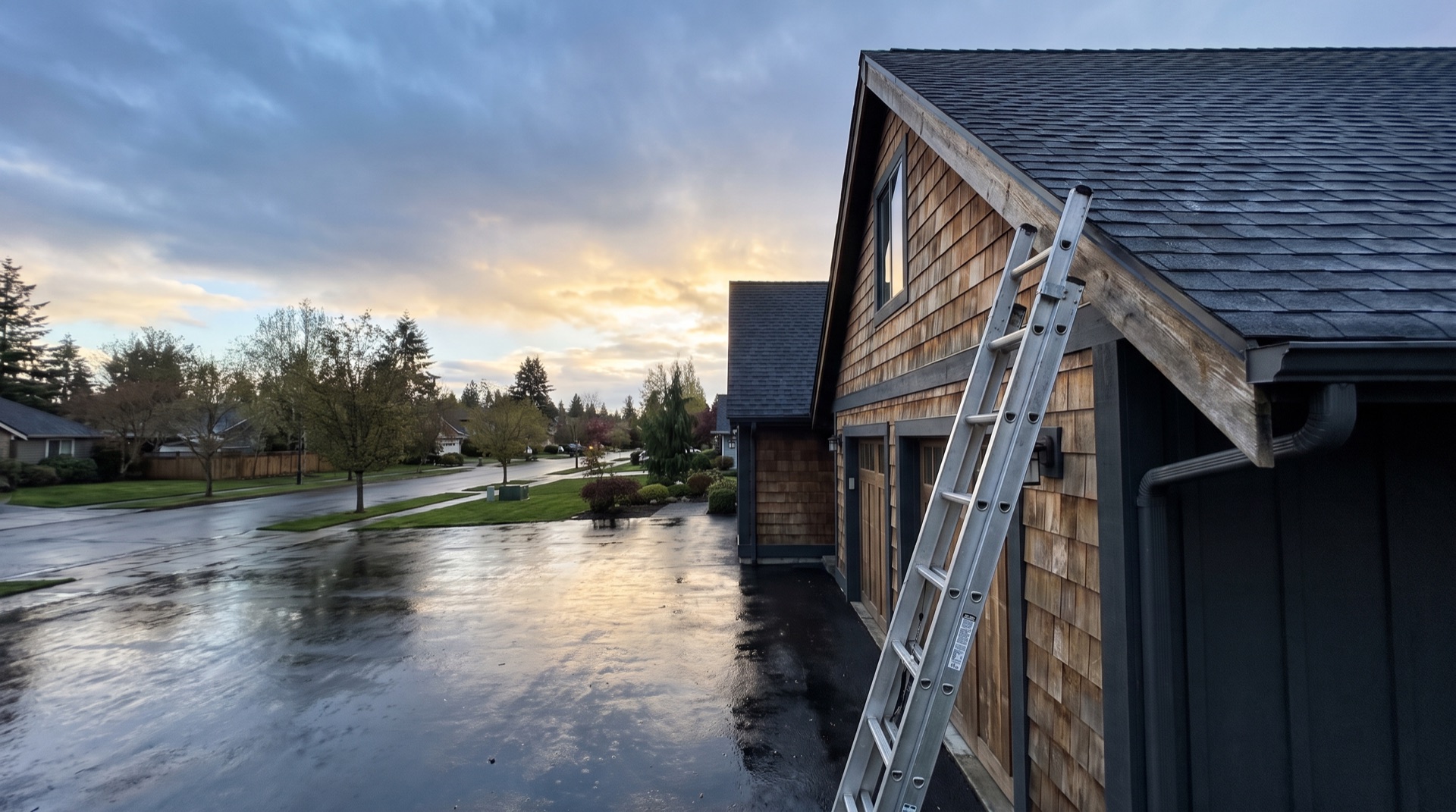
A storm damage roof inspection works best in a fixed order: photograph what you can see from the ground yourself, report the damage to your insurer and let the adjuster it sends look at the roof, then pay for an independent inspection only if you still need a second opinion. The inspection a stranger offers you at your front door two days after the hail sits outside that order. It is a sales call with a ladder, and the FTC and FEMA both publish warnings about the people making it.
What you can see from the ground yourself
This costs nothing and it is the only part of the sequence where nobody else has an interest in the answer. Three places are worth looking.
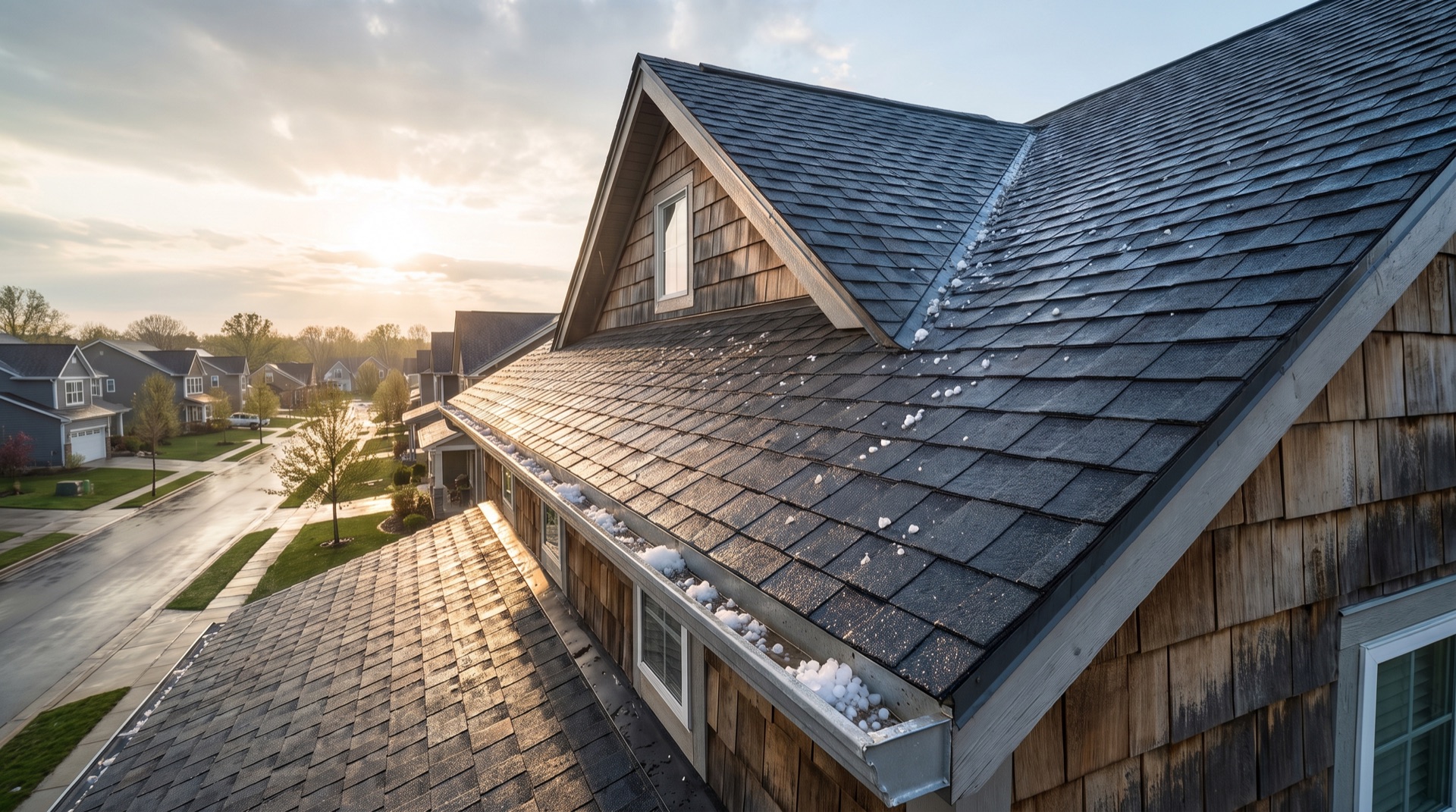
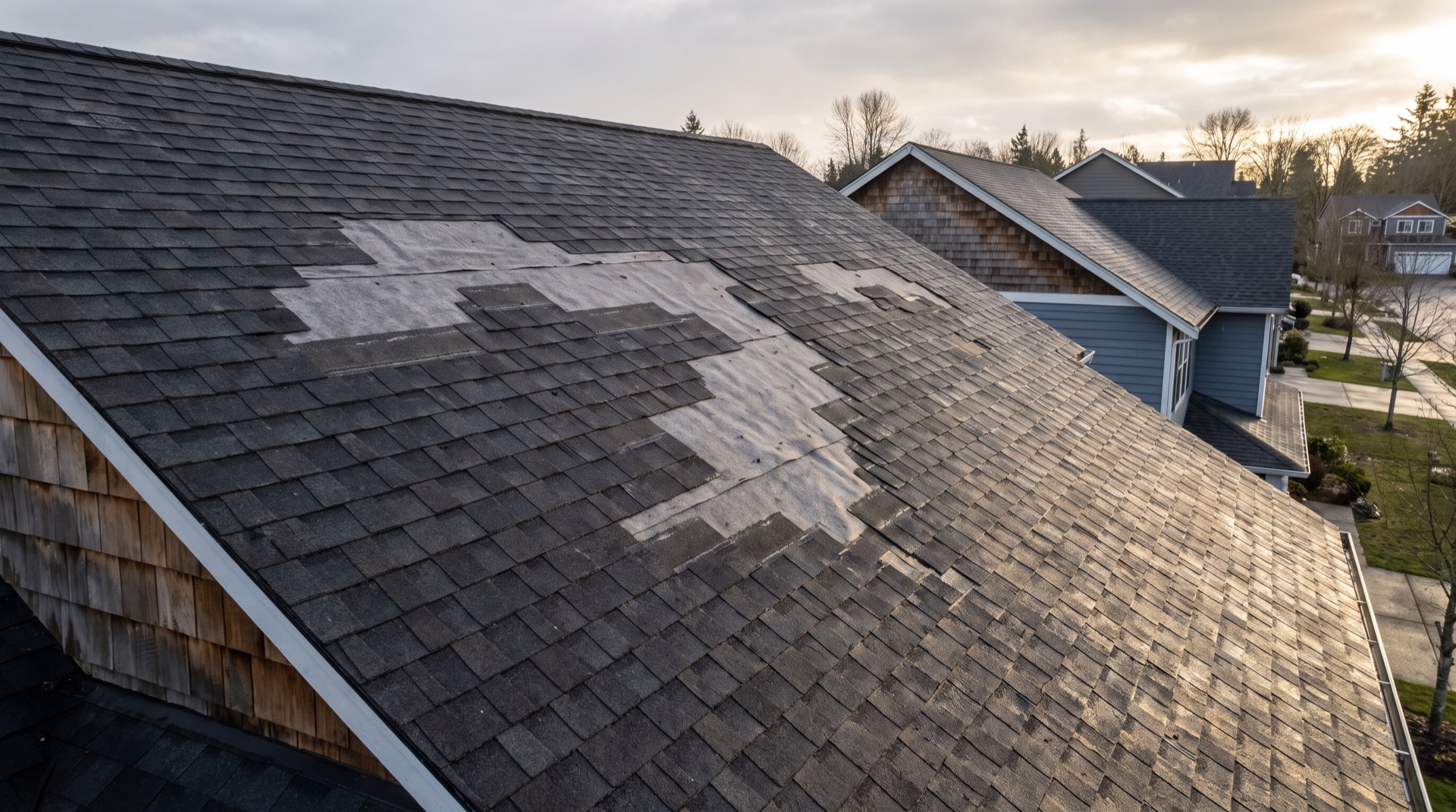
The roof covering. From the ground or an upstairs window, look for shingles that are missing, lifted, creased or torn, and for a course that sits out of line with the ones beside it. The Insurance Institute for Business and Home Safety explains in Roof 101, in its account of how a newly installed roof seals itself, that asphalt shingles carry a sealant layer that "activates under the heat of the sun to self-seal the shingles together following installation," and that "until shingles are fully sealed, wind and rain pose a risk to the roof. Wind can lift unsealed shingles, and water can seep underneath the shingle." IBHS is describing shingles that have not sealed yet rather than storm damage, but it is the clearest published account of what an unsealed shingle leaves open, and it is why we treat a lifted shingle as worth photographing rather than ignoring.
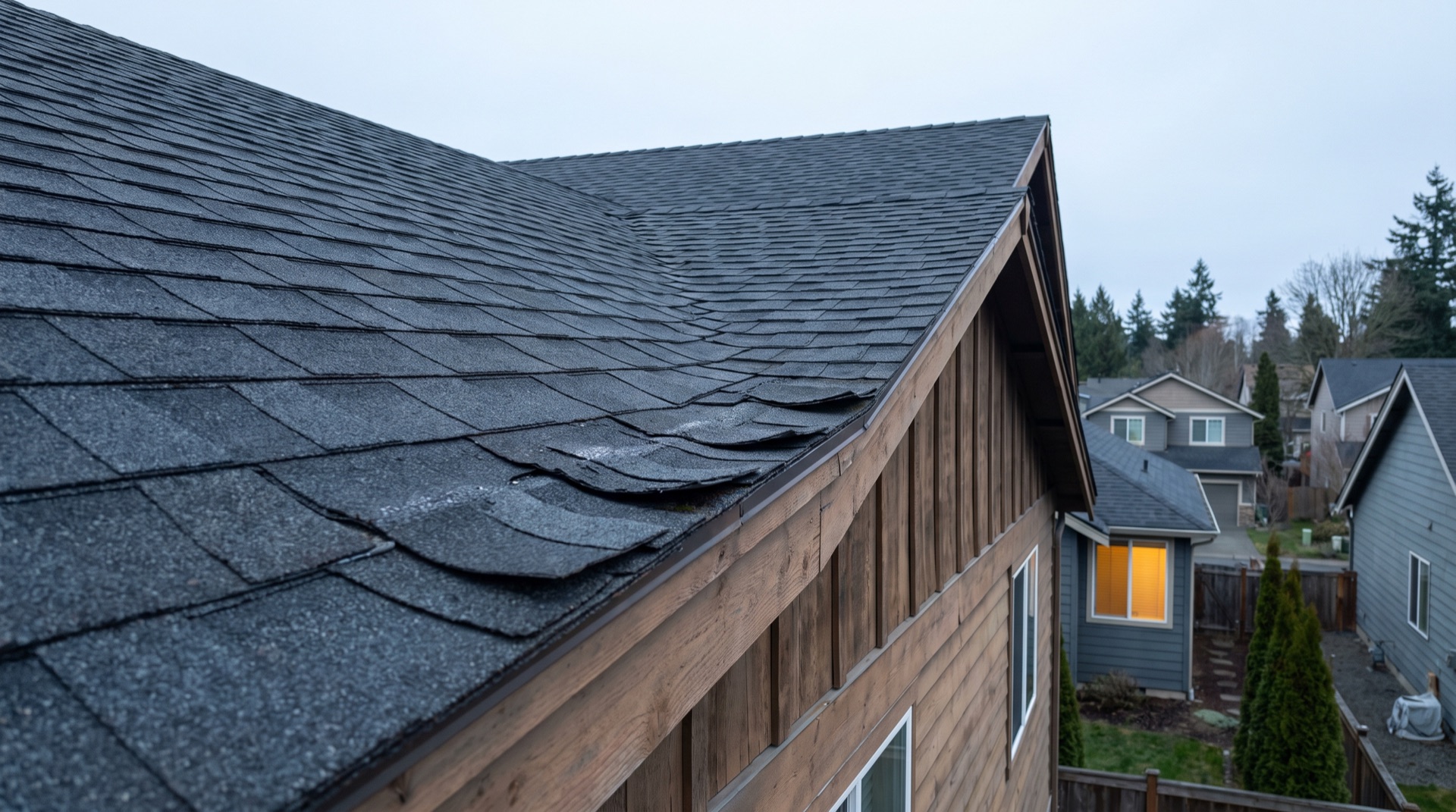
The soft metal and the gutters. Our own rule of thumb is to start with gutters, downspouts, roof vents, the air conditioner fins and any metal flashing, because a dent in soft metal is easier to see from the ground than a bruise on a shingle. Treat that as our suggestion for where to point the camera first, not a published inspection standard. Granules in the gutter or at the bottom of a downspout are worth photographing too: IBHS describes granules as "coated rocks that protect the fiberglass from damaging UV rays," which is our reason for mentioning them to the adjuster. IBHS does not say how much granule loss matters, and neither will we.
Inside the house. Ceiling stains, damp patches in the attic and daylight visible through the roof deck are all worth photographing, with the date.
Photograph everything before you touch it. The Texas Department of Insurance's storm recovery guidance is direct about the sequence: "Take pictures and video of the damage. Don't throw anything away until your insurance adjuster tells you." It also says to "make temporary repairs to prevent more damage," to "keep a list of the repairs and save receipts," and not to "make permanent repairs before the insurance adjuster sees the damage." Temporary work to keep water out is expected; permanent work before the inspection removes the evidence.
It also helps to know what actually passed over your address and when, because the clock starts with the storm: the NAIC says "most insurance companies have a time requirement for reporting a claim, so contact your agent or company as soon as possible." Which storm it was, and when, is hard to reconstruct six months later.
What the insurer's adjuster does, and who pays for it
When you report damage, your insurer assigns an adjuster to work out what happened and what your policy owes. The NAIC's guide to navigating the claims process sets out both halves of this plainly: your insurer "will send a claims adjuster to assess the damage at no cost to you," and that adjuster "will walk through your home to inspect damaged items and temporary repairs. They may look at the outside of your home, your roof or your basement."
So the first real inspection of your roof is one you do not pay for. That single fact undercuts most of what gets said on a doorstep after a storm.
Two things are worth being clear-eyed about. The first is our reading rather than anything the NAIC says: the adjuster is the one the insurer sends and pays, so we treat the resulting estimate as the company's opening position rather than a neutral verdict. The second is that what the estimate turns into depends on your policy's settlement basis, which is decided long before the storm. The NAIC's own replacement cost and actual cash value example shows the size of that difference: two families with $15,000 of roof damage and $1,000 deductibles, one paid $14,000 under replacement cost, the other $4,000 once $10,000 of depreciation came off under actual cash value. The roof replacement guide works through that choice in full.
Have your own photographs, your list of damage and your receipts ready for that visit. The NAIC's claims guidance is to "take photos or video and make a list of the damages and lost items." Documentation you took before anything was moved is the most useful thing you can bring.
What a paid, independent inspection buys you
Once the adjuster has been, a paid inspection is a real option, and it is worth being precise about what you are buying.
An inspection from someone who will not do the repair — a licensed home inspector, or a professional engineer where the question is structural — gives you a written opinion from a party with no stake in the size of the job. That is the whole value. It does not bind your insurer to anything, it does not decide the claim, and it is one qualified opinion rather than a ruling.
A public adjuster is a different role again. The Texas Department of Insurance describes it as someone you "hire ... to negotiate with your insurance company to settle your claim," paid out of the settlement: in Texas "public adjusters can charge up to 10% of the total amount the company will pay for your claim," and you can ask for that fee as a dollar amount in the contract instead of a percentage. Texas also bars the two roles from merging: "public insurance adjusters who work on your claim can't act as your contractor," and "contractors can't advertise that they'll handle your insurance claim." Those limits are Texas rules. Every state licenses adjusters on its own terms, so check your own state insurance department for the fee cap and the license status of anyone you are considering.
What a "free inspection" at your door actually costs you
Search this topic and most of what you find is published by companies that want the repair work. Their inspection is free in the sense that no invoice arrives. The price is paid elsewhere.
It is paid in access. Someone with a financial interest in finding damage goes up on your roof, unsupervised, with no record of its condition beforehand. A FEMA Region 6 fact sheet on post-disaster contractor fraud, issued for survivors of the July 2025 Central Texas storms and flooding, puts the reason to be careful about who that someone is plainly: "Out-of-town scam artists may be the first to arrive at your front door after a flood." That fact sheet is written for one disaster in one state, and it points Texans at the Texas Department of Licensing and Regulation, but its recommendations travel: use "a local contractor, someone who is known in the community," "only work with contractors who are licensed, registered and have insurance," and "get two or three written estimates."
It is paid in signatures. The document that follows a free inspection is often not an estimate. The NAIC's warning on assignment of benefits explains what one is: "an agreement signed by a policyholder that allows a third party—such as a water extraction company, a roofer or a plumber—to act on behalf of the insured and seek direct payment from the insurance company." What it costs you is control: "the third party, like a roofing company or plumber, files your claim, makes the repair decision and collects insurance payments without your involvement," and "once you have signed an AOB, the insurer only communicates with the third party and the other party can sue your insurer and you can lose your right to mediation." What mediation you have to lose is a matter of state law and the terms of your policy, so the weight of that last point varies by state. The NAIC is equally plain about the alternative: "You are not required to sign an AOB to have repairs completed. You can file a claim directly with your insurance company, which allows you to maintain control of the rights and benefits provided by your policy in resolving the claim."
It is paid in hurry. The FTC's guidance on scams after weather emergencies says "unlicensed contractors and scammers often appear in recovery zones," to "be skeptical of anyone promising immediate clean-up or repairs," that "if they want cash up front, walk away," and to "never sign your insurance check over to a contractor." It adds that "if they won't give you copies of their license, insurance, or a contract in writing, that's a red flag," and that suspected scams can be reported at ReportFraud.ftc.gov.
Some of this is regulated rather than merely unwise. The Texas Department of Insurance points out that "Texas doesn't allow a roofer or contractor to act as a public insurance adjuster on insurance claims if they're also doing the work", that it is "illegal in Texas for a contractor to offer to waive, rebate, or absorb a property policyholder's deductible," and that contracts of $1,000 or more involving an insurance settlement must carry a notice that the policyholder has to pay the deductible. Texas separately lists, among the things a licensed public adjuster can't do, "knock on your door asking for business during a natural disaster or after 9 p.m." Other states draw these lines differently, and some barely draw them at all.
None of that means a roofer who knocks is dishonest. It means the sequence is backwards. A company that is still worth hiring next week will still be worth hiring next week.
Your options, in order
The first two cost nothing, and most people can take them in sequence rather than choosing between them.
If you are still unsure after the adjuster's visit, that is the point at which paying an inspector with no stake in the repair starts to earn its fee — not before, and not at the door.
Bottom line
The order is what protects you: your own photographs first, your insurer's adjuster next at no charge to you, and a paid independent opinion last, if you still want one. Verify any contractor's license and insurance with your state yourself, get two or three written estimates on the same scope, and read anything put in front of you before signing, especially if it assigns your claim to someone else. Nobody reputable needs that signature today.
If hail was involved, the hail-damage walkthrough covers the first days in order. When it comes time to hire, what to verify before you choose a roofer is the page to read before you sign anything.
Common questions
Do I need a roof inspection after a storm?
You need to know whether there is damage, which is not the same as needing to hire an inspector. Start with photographs from the ground and from inside the house, and let the insurer's adjuster inspect if you report a claim.
Does the insurance adjuster's inspection cost me anything?
No. The NAIC says that after you report damage, your insurer will send a claims adjuster to assess it at no cost to you. A public adjuster is a different role that you hire and pay for yourself.
Should I let a roofer who knocked on my door inspect my roof?
You are never obliged to. The FTC warns that unlicensed contractors and scammers often appear in recovery zones, and a FEMA fact sheet issued after the July 2025 Central Texas storms and flooding noted that out-of-town scam artists may be the first to arrive at your front door after a flood.
What should I do before anyone inspects the roof?
Take pictures and video, make temporary repairs to stop further water getting in, and keep the receipts. The Texas Department of Insurance advises against permanent repairs before the adjuster has seen the damage.
What is an assignment of benefits, and do I have to sign one?
It is an agreement letting a third party such as a roofer deal with your insurer and be paid directly. The NAIC states you are not required to sign one to have repairs completed, and that signing can cost you your right to mediation.
Sources
- NAIC: Navigating the Claims Process — Recover and Rebuild
- NAIC: Assignment of Benefits — Consumer Beware
- NAIC: Rebuilding After a Storm — Replacement Cost vs. Actual Cash Value
- FTC Consumer Advice: How To Avoid Scams After Weather Emergencies and Natural Disasters
- FEMA Region 6 fact sheet (Texas, DR-4879): Beware of Post-Disaster Contractor Fraud
- FTC Consumer Advice: How To Avoid a Home Improvement Scam
- Texas Department of Insurance: Help after a storm
- Texas Department of Insurance: Public adjusters
- Texas Department of Insurance: Roofing and insurance — Know the law
- IBHS: Roof 101
By RoofWise USA Editorial Team. First published September 17, 2026. Advertiser disclosure