Guide
Actual Cash Value vs Replacement Cost on a Roof Claim
Actual cash value pays your roof's depreciated value; replacement cost pays without deducting depreciation. What each means on a roof, and where to check yours.
Updated September 17, 20269 min readReviewed by RoofWise USA Editorial Team, editorial review: primary sources checked and independently fact-checked
Actual cash value vs replacement cost is the single line in a homeowners policy that decides how much of a roof you get paid for. The National Association of Insurance Commissioners, the body US state insurance regulators run together, states the rule directly: with replacement cost value coverage "your policy will pay the cost to repair or replace your damaged property without deducting for depreciation," while with actual cash value coverage "your policy will pay the depreciated cost to repair or replace your damaged property." A roof loses value with every year it ages, so on a roof the gap between those two settlements is usually the largest of anything in the house.
What each basis means on a roof
Both terms describe how the settlement is calculated, not what is covered. Whether the damage is covered at all is a separate question, decided by the cause of loss and the terms of your own policy, and the pillar guide on roof replacement walks through where insurance fits in the wider decision.
Replacement cost value, usually shortened to RCV, is the cost to put the roof back. The NAIC's explainer on the two bases describes it as paying "the cost to repair or replace your damaged property using materials of a like kind and quality." The age of the roof does not reduce that figure.
Actual cash value, or ACV, is replacement cost minus depreciation. The same NAIC page describes it as paying "based on its value, considering its age and wear and tear (depreciation)," and is blunt about the consequence: ACV coverage "pays for your loss but often does not pay enough to fully replace your property or repair the damage."
The NAIC's Consumer's Guide to Home Insurance uses the same two definitions for the house as a whole: replacement cost is "the cost to rebuild your home or repair damages using materials of similar kind and quality," and actual cash value is "the value of your home considering its age and wear and tear."
On contents, that gap is annoying. On a roof, it is the whole job, because a roof is a large single-purpose item with a long, well-documented useful life, and the depreciation schedule runs against it from the day it goes on.
The NAIC's worked roof example
This is the clearest published illustration of the difference, and it is about a roof specifically. In the NAIC's Post-Disaster Claims Guide, the Smiths and the Johnsons are next-door neighbors with the same house, the same floorplan and roofs of the same age. A storm destroys both. Both roofs cost $15,000 to replace, and both households have a $1,000 deductible.
The Smiths hold a replacement cost policy. No depreciation is applied, the $1,000 deductible comes off, and the payment is $14,000.
The Johnsons hold an actual cash value policy. The guide applies a depreciation schedule of $1,000 a year against a ten-year-old roof, so $10,000 comes off first, then the $1,000 deductible. The payment is $4,000.
Same storm, same roof, same deductible, a $10,000 difference in what arrives. Nothing about the damage produced that gap. A term written on the policy years earlier did.
Those figures are the NAIC's illustration, not a national average. We do not publish roof price averages here, because no authoritative body publishes one and the real number depends on your roof, your region and the year.
How depreciation is calculated on a roof
The NAIC says insurers "usually calculate depreciation based on the condition of the property when it was lost or damaged, what a new one would cost, and how long the item would normally last." Three inputs: condition, current replacement price, and expected useful life.
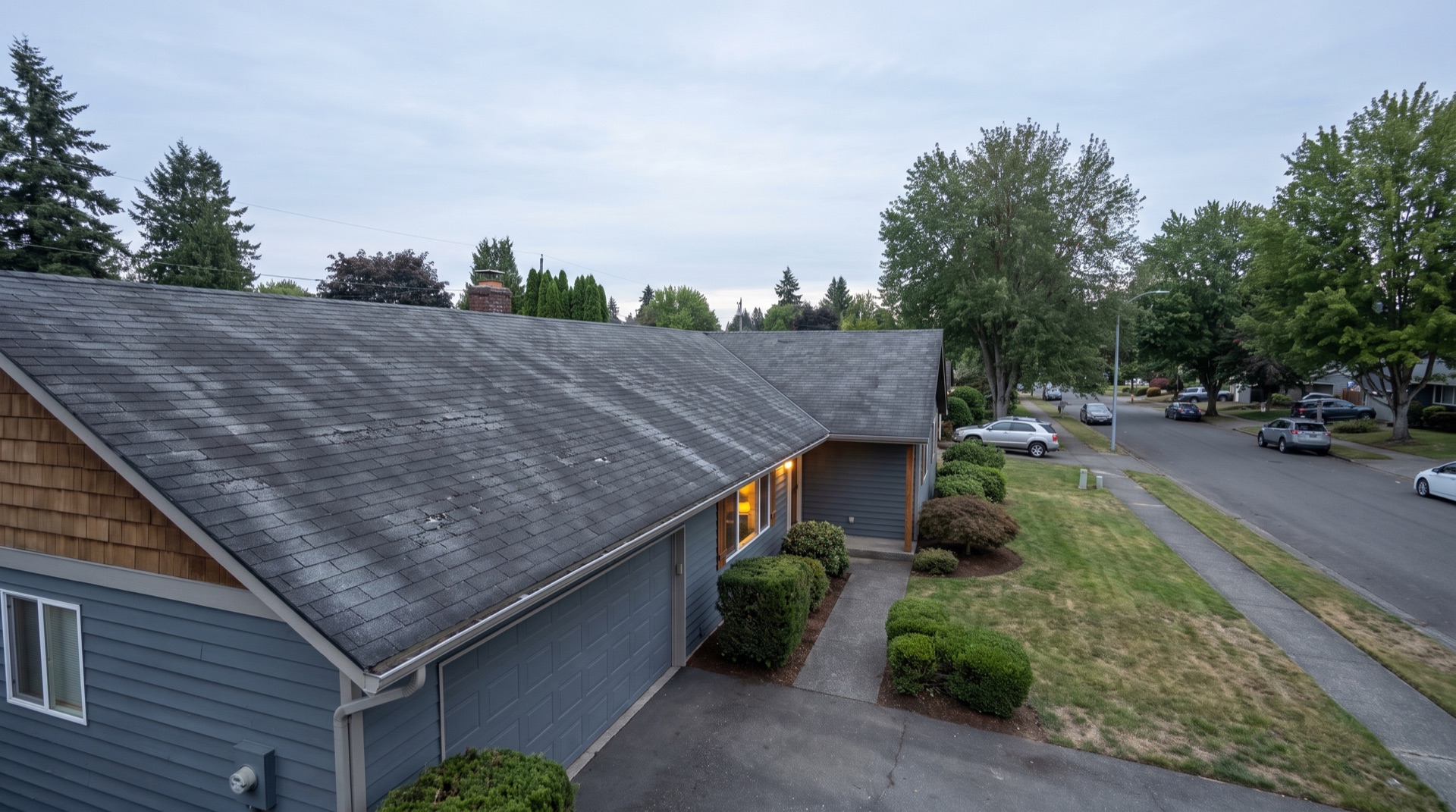
The Post-Disaster Claims Guide gives the roof version. It notes that "the useful life of a roof is usually about 25 years," and that if a covered loss destroys a 20-year-old roof, a policy paying RCV covers the full cost to replace it, while "an ACV policy may pay as little as 20% of the cost to replace the roof."
That is the mechanism behind a pattern people find unfair but which is simply arithmetic: the older the roof, the less an ACV settlement covers. On the straight-line schedule the NAIC uses in its example, the shortfall grows by the same amount every year.
The NAIC is also careful to separate this from other uses of the word. Depreciation in an insurance claim "is much different than depreciation on assets for taxes and is different from an accountant's calculation of depreciation on property."
Recoverable depreciation, and why the first cheque looks small
A common surprise: you hold a replacement cost policy, and the first payment still arrives at actual cash value. The NAIC explains that this is normal, and how the rest is released.
"When you have an RCV policy and turn in a claim for a covered loss, the insurer at first may pay only the ACV for the damage to your home or personal property. But, when you present evidence that the damaged property has been repaired or replaced, the insurer will pay the difference (this is referred to as 'recoverable depreciation') up to the replacement cost." The guide defines it as "the difference between an item's replacement cost and ACV."
Two practical consequences follow from the mechanism itself.
The withheld portion is paid on evidence of completed work, so under this structure the money for the second half arrives after the work, not before. And there is usually a clock. The NAIC says the time limit "can range from 6 months to up to one year, depending on your state's laws and your policy," that insurers will extend it after a very large-scale disaster if you ask, and that your state insurance department may require them to.
Recoverable depreciation exists only under a replacement cost policy, so an actual cash value settlement has none to release. The depreciated amount is the settlement.
Where to find your own settlement basis
You do not have to guess. The NAIC's instruction is specific: "Check the declarations page of your homeowners policy to see whether the policy provides replacement cost coverage. If it doesn't specify replacement cost, then your policy likely only covers actual cash value. If it specifies replacement cost, then you have replacement cost coverage."
The declarations page is the summary page at the front of the policy. The NAIC's instruction is specific: check it to see whether the policy provides replacement cost coverage.
Two things on that page are worth reading in the same sitting.
A roof-specific limitation. The NAIC warns that "even if you bought an RCV policy, there may be other limits on what the policy will pay for damage to certain surfaces, such as roofs. In some cases, the policy may pay ACV on your roof, but RCV on the rest of your home and property." This is why some readers are certain they hold replacement cost coverage and are still settled on a depreciated basis. The NAIC's suggestion is to "call the adjuster or your insurer and ask what type of coverage you have."
Your deductible, including any separate one. A deductible is "the part (or amount) of the claim you're responsible for," and it comes off in addition to any depreciation. The NAIC notes that some policies carry a special deductible for wind, hurricane or storm losses, and that some apply a special deductible to a specific part of the home "like your roof," as either a flat dollar amount or a percentage. A percentage deductible is calculated against your dwelling coverage, not against the size of the claim, which catches people out.
"Like kind and quality" is a separate limit
Replacement cost does not mean an upgrade. The NAIC explains that "most" replacement cost policies cover repairs "with property of 'like kind and quality'," and gives the roofing example: "if you had a 3-tab shingle roof before the loss, your insurance policy would cover the cost of another 3-tab shingle roof, but not a more expensive slate roof."
The guide also describes functional replacement coverage, which is "becoming more common, particularly with older homes." It "replaces the damaged property with a functional replacement, which isn't necessarily the same quality and craftsmanship as the original materials," and the roofing example the NAIC gives is replacing a tile roof with a shingle roof. That is a third basis, not a variant of the first two,
One more line item that often decides whether a roof job is affordable: current building codes. The NAIC says standard homeowners policies "don't cover the added expense to meet current building codes when you repair or replace your home," that roofing materials are among the things that may need updating, and to "look at the declarations page of your policy to see if you have Ordinance and Law coverage."
What to do with the answer
Once you know your basis, the next step is usually the same one.
Your insurer can confirm in one call which basis applies to the roof, whether a separate wind or hail deductible applies, and what evidence releases any withheld depreciation. If you disagree with how a claim is handled, the NAIC directs consumers to their state department of insurance.
Where the pages ranking for this question fall short
Search this phrase and you will mostly get insurance carriers, agencies and roofing companies. Two patterns are worth naming.
The first is that many of them answer a question you did not ask. You searched for what the two terms mean; the page tells you which coverage to buy, which conveniently is the one the publisher sells or the one that makes a roof job easier to sell. We will not tell you that. Which coverage suits your house, your roof's age and your budget is a decision for you with a licensed agent or your state insurance department, and it involves a premium trade-off that no article knows anything about.
The second is confident dollar figures. Depreciation schedules, useful-life assumptions and replacement prices vary by insurer, by policy and by region. The NAIC's $15,000 roof is an illustration in a consumer guide, and we quote it as one. Any page telling you what your roof is worth after depreciation, without seeing your policy, is making it up.
Bottom line
Replacement cost pays to put the roof back without deducting for age; actual cash value pays what the aged roof was worth, and on a roof near the end of its useful life that can be a small fraction of the job. Your declarations page says which one you have, and it may say something different for the roof than for the rest of the house. Read it before you need it, and call your insurer to confirm anything the page leaves ambiguous.
For whether the damage is the kind a policy responds to at all, see does insurance cover a roof replacement. If you have already had an answer you disagree with, the free routes after a denial come before the paid ones.
Common questions
What is the difference between actual cash value and replacement cost on a roof?
The NAIC puts it in one line: replacement cost coverage pays the cost to repair or replace your damaged property without deducting for depreciation, while actual cash value coverage pays the depreciated cost. On a roof, that difference grows every year the roof ages.
How do I find out which one my policy uses?
The NAIC says to check the declarations page of your homeowners policy to see whether the policy provides replacement cost coverage. If it does not specify replacement cost, your policy likely only covers actual cash value, and the NAIC suggests calling the adjuster or your insurer to confirm.
What is recoverable depreciation?
Under a replacement cost policy, the insurer may at first pay only the actual cash value. When you present evidence that the property has been repaired or replaced, the NAIC says the insurer pays the difference, up to the replacement cost. That difference is the recoverable depreciation.
Can a replacement cost policy still pay actual cash value on the roof?
Yes. The NAIC notes that even with a replacement cost policy there may be other limits for certain surfaces, and that in some cases a policy may pay actual cash value on your roof but replacement cost on the rest of the home.
Is the deductible taken out on top of depreciation?
In the NAIC's roof example, yes. The actual cash value household had $10,000 of depreciation and then the $1,000 deductible subtracted from a $15,000 roof, leaving a $4,000 payment. Your own policy decides how your deductible is calculated.
Sources
- NAIC: Rebuilding After a Storm — Replacement Cost vs. Actual Cash Value
- NAIC: What's the Difference Between Actual Cash Value Coverage and Replacement Cost Coverage?
- NAIC: Post-Disaster Claims Guide (PDF)
- NAIC: A Consumer's Guide to Home Insurance (PDF)
By RoofWise USA Editorial Team. First published September 17, 2026. Advertiser disclosure