Guide
Does Insurance Cover Roof Replacement? It Depends on the Cause
It turns on what damaged the roof and on your policy's settlement terms. Here is how cause, roof age and the settlement basis each change the answer.
Updated September 17, 20268 min readReviewed by RoofWise USA Editorial Team, editorial review: primary sources checked and independently fact-checked

Whether insurance covers roof replacement turns on two separate questions, and most pages answer only the first one. The first is cause: damage that happened suddenly, from a peril your policy lists, is treated differently from a roof that has gradually worn out. The second is the settlement basis your policy is written on, which decides how much of the bill lands on you even when a claim is accepted. Both halves are set before the storm arrives, and you can read both of them off your own policy today.
What "covered" actually means: the cause comes first
A home policy is built around sudden, accidental events rather than the slow decline of a building. The Texas Department of Insurance's home insurance guide lists what most policies cover: "Fire and lightning, Sudden and accidental release of water or smoke, Explosion, Theft, Vandalism, malicious mischief, riot, and civil commotion, Aircraft and vehicles, Windstorm, hurricane, and hail (but not if you live on the Gulf Coast)." The same page carries a caveat worth reading twice: "Coverages vary by company. Read your policy or talk to your agent to be sure of your exact coverages." The guide also lists what most policies do not cover, and "Wear and tear" is on that list alongside continuous water leaks, insects and earth movement.
Applied to a roof, that line is less fuzzy than it sounds. Shingles torn off in a windstorm, or a mat bruised through by hail, are events with a date. A covering that has slowly shed its granules, or whose shingle edges have curled, has no such date — in our reading that is a roof wearing out rather than a roof that was damaged. TDI's page on what a home policy won't cover groups worn roofs with rotted boards and cracking window seals: "Companies won't pay for damages that happen over time."
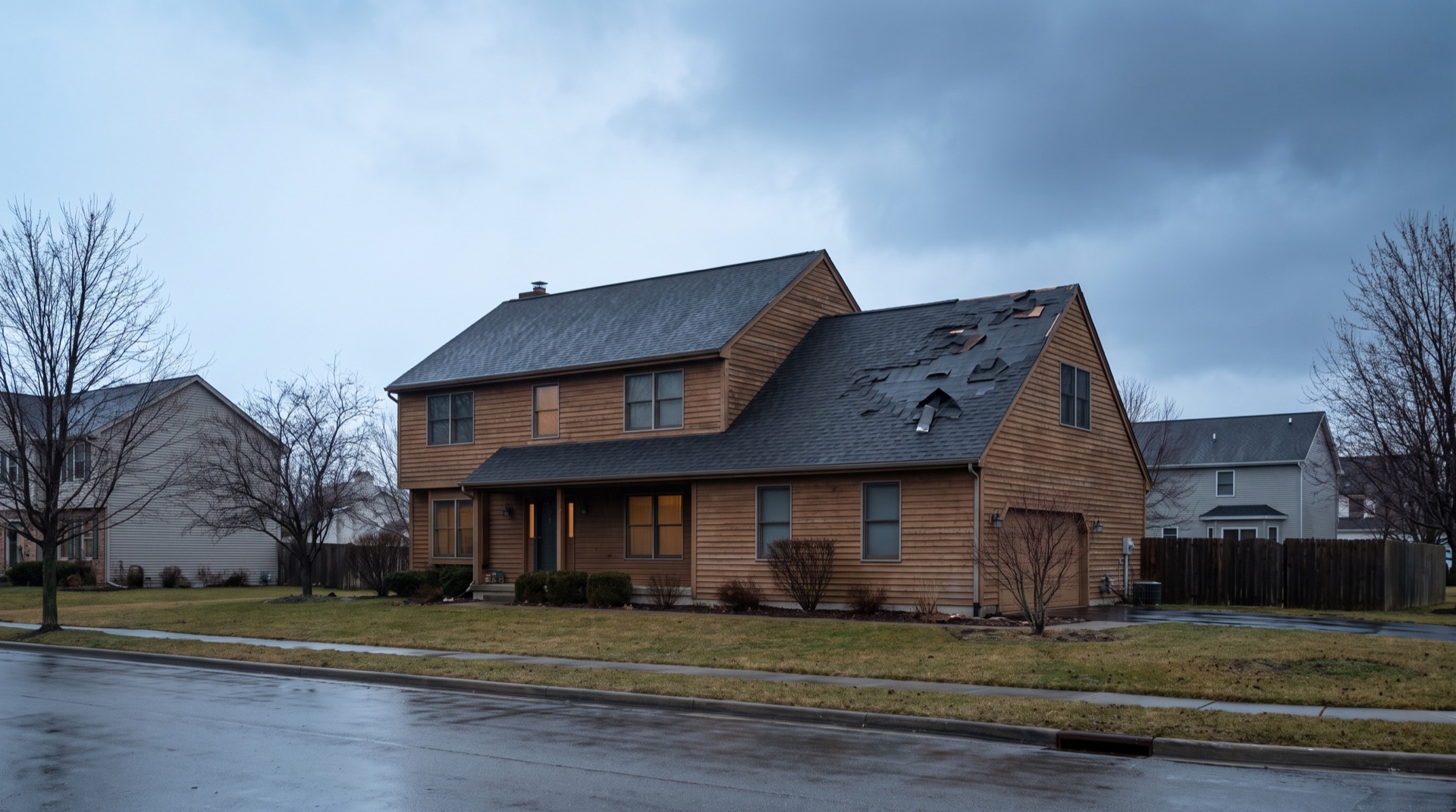
In practice a single roof often has both on it at once, which is why two people with the same age of roof and the same storm can get different answers. None of the sources on this page describe how an adjuster weighs a roof carrying both, and we won't invent a method for them — but the line TDI draws, between a sudden event and damage that happens over time, is the line your claim will be read against.
Your roof's age can change the answer before any storm
This is the part that surprises people, and it is worth knowing well before you need it.
TDI's page on insurance and your roof describes two things that happen as a covering ages. First, the settlement terms can change: "As roofs age, some companies will switch to actual cash value." Second, at the far end, the coverage itself can go: "And if your roof is in poor condition, your company might not cover your roof at all." TDI adds that "your company should tell you when they change your coverage" — which means the notice probably arrived in an envelope you have already filed somewhere. Its advice is to catch it at renewal: "When you renew your policy, check to see if there are changes to your roof coverage."
So the practical question is not only "is my roof damaged." It is what your own policy actually says, and TDI's instruction is blunt: "Read your policy or talk to your agent to be sure of your exact coverages." The declarations page is where to start, and it is a ten-minute job with the policy in front of you. TDI describes that page as the first page of your policy, carrying "a summary of your policy, including your coverages, dollar limits, and deductibles." The NAIC's post-disaster claims guide goes a step further on the settlement basis: "Check the declarations page of your homeowners policy to see whether the policy provides replacement cost coverage. If it doesn't specify replacement cost, then your policy likely only covers actual cash value."
How much: the half the ranking pages bury
Search this question and you will get a run of insurer content hubs and aggregator articles that answer the cause question, sometimes well, and then trail off. The money question gets a sentence near the bottom, if it appears at all. That ordering is backwards, because two households with identical damage and identical deductibles can end up thousands of dollars apart on the strength of one phrase in their policies.
The phrase is the settlement basis. The National Association of Insurance Commissioners sets the two side by side: with replacement cost coverage "your policy will pay the cost to repair or replace your damaged property without deducting for depreciation," while with actual cash value coverage "your policy will pay the depreciated cost to repair or replace your damaged property." Depreciation is usually calculated, the NAIC says, from "the condition of the property when it was lost or damaged, what a new item would cost, and how long the item would normally last." Elsewhere the NAIC is blunt about what that means in practice: actual cash value coverage "pays for your loss but often does not pay enough to fully replace your property or repair the damage."
The NAIC's own example makes the gap concrete. Two families each had $15,000 of roof damage and a $1,000 deductible. The family with replacement cost coverage received $14,000. The family with actual cash value coverage received $4,000, after $10,000 of depreciation and the same deductible. A separate guide on this site works through that distinction in detail; the short version is that an older covering on an actual cash value policy can leave most of a replacement uninsured, entirely lawfully, with nothing having gone wrong in the claim.
Two more numbers sit between the estimate and the money. The deductible is, in the NAIC's words, "the part (or amount) of the claim you will have to pay out of pocket," and the NAIC suggests asking your insurer "if there are separate deductibles for damage caused by wind or hail" and whether "you have a separate deductible for your roof or other structures." And on replacement cost policies, TDI notes the payment usually arrives in two parts: "The first check will be a partial payment. Your company will send the rest of your claim amount after you've started repairs." Budgeting as though one check covers the job is a common and expensive surprise.
What you can find out before you call anyone
Four facts, all of them on paper you already have, decide most of this conversation:
- The date and cause of the damage, and whether anything about it was sudden.
- Roughly how old the covering is. A closing document, a permit record or the county property record usually has it.
- Whether your roof is settled at replacement cost or actual cash value, from the declarations page.
- Your deductible, and whether a different one applies to wind and hail.
On timing, TDI's guide says to "tell your company as soon as possible," notes that "most companies have deadlines for you to file a claim," and that "some policies have a one-year deadline unless you can show good cause for the delay." Whether to open a claim at all is your call to make with those four facts in hand, and the deductible is often the figure that settles it.
Your options from here
Those two are not alternatives so much as a sequence. Reading the policy and talking to your own insurer costs nothing and tells you which of the two questions at the top of this page is actually the problem. Getting quotes tells you the size of the job. The roof replacement guide covers what the work involves and what moves the price, whichever way the claim goes.
Bottom line
The honest answer has two halves. Cause decides whether a roof loss is a claim at all, and a covering that has worn out with age generally is not one. The settlement basis then decides how much of an accepted claim you carry — the NAIC's advice is to look for it on your declarations page — and on actual cash value that share can be most of it. Read those two things off your own policy before you talk to a roofer, and you will be the best-informed person in the conversation.
The settlement basis is what decides the amount, and actual cash value against replacement cost works through it in full. If you have decided to go ahead, the order to file in protects your position.
Common questions
Does homeowners insurance cover roof replacement?
It depends on what caused the damage and on the terms of your own policy. Sudden damage from a peril the policy covers, such as wind or hail, is treated differently from a roof that has worn out with age. Even when a claim is accepted, the settlement basis decides how much of the cost is yours; the NAIC's post-disaster claims guide tells readers to check the declarations page to see whether the policy provides replacement cost coverage.
Does insurance cover a roof that is simply old?
The Texas Department of Insurance puts it plainly: your insurance company won't pay for a new roof just because it's old or worn out. Home policies are written around sudden events, and damage that happens gradually sits with the homeowner.
How much difference does actual cash value make?
A lot. The NAIC's worked example follows two families with $15,000 of roof damage and $1,000 deductibles: the family with replacement cost coverage received $14,000, and the family with actual cash value coverage received $4,000 after $10,000 of depreciation.
Is there a separate deductible for wind and hail damage?
There can be. The NAIC suggests asking your insurer whether separate deductibles apply to wind or hail damage, and whether your roof carries its own deductible. That figure is on your declarations page, not in any general guide.
How long do I have to report roof damage?
Sooner is safer. The Texas Department of Insurance says to tell your company as soon as possible, that most companies have deadlines for filing a claim, and that some policies have a one-year deadline unless you can show good cause for the delay.
Sources
- NAIC: Rebuilding After a Storm — Replacement Cost vs. Actual Cash Value
- NAIC: What's the Difference Between Actual Cash Value Coverage and Replacement Cost Coverage?
- Texas Department of Insurance: Insurance and your roof
- Texas Department of Insurance: Five things your home policy won't cover
- Texas Department of Insurance: Home insurance guide
- Texas Department of Insurance: Is it OK for a contractor to waive my deductible?
- NAIC: Post-Disaster Claims Guide
- NAIC: Insurance Departments (find your state regulator)
- FTC Consumer Advice: How To Avoid Scams After Weather Emergencies and Natural Disasters
By RoofWise USA Editorial Team. First published September 17, 2026. Advertiser disclosure