Guide
How to File a Roof Insurance Claim, in the Order That Protects You
Photograph the damage, read your own policy for the deadline and deductible, then call your insurer yourself. The order matters more than the speed.
Updated September 17, 202612 min readReviewed by RoofWise USA Editorial Team, editorial review: primary sources checked and independently fact-checked

Here is how to file a roof insurance claim in the order that protects you: photograph the damage before anything is touched, read your own policy for the reporting deadline and the deductible, then call your insurer or agent yourself and get a claim number. After that, do what you can to stop further damage, and keep every receipt. The order is the part most pages get wrong. Photographs taken before the tarp goes on are the clearest record you will have of what the storm did, and the NAIC wants that tarp up promptly — so the camera comes first, not instead. The deductible you never checked, meanwhile, decides whether filing was worth doing at all.
Why "call a roofer first" is the wrong first step
A lot of the advice on this question starts with "have a roofing company inspect the damage and meet the adjuster," often as step one or two. That is not illegal or even always wrong, but this is our own view: a company that wants the job is not a neutral source on how early to involve it, and it is not the order the consumer regulators set out.
The NAIC's Post-Disaster Claims Guide opens with safety, then securing the property, then reporting the claim. The only mention of a contractor alongside the adjuster in the NAIC's consumer guide to home insurance comes in the section on disagreements: "If there are disagreements between you, the insurer and the claims adjuster, first try to resolve them with your insurer... It might help to have your contractor meet with you and the insurance adjuster." That is an option for later, when there is something to disagree about. It is not the beginning of the process.
You may absolutely have a roofer look at your roof. Bring one to the adjuster visit if you want a second set of eyes on the scope. Just do it because you decided to, after you know what your own policy says, rather than because the first company to knock told you it was required.
Step 1: Document the damage before anything changes
Take photos and video of every damaged area, from the ground, from a window, and from inside the attic if you can get there safely. The NAIC's guidance while inspecting is direct: "Take photos or videos of the damaged areas and personal property. You also can jot down notes about any significant damage you see."
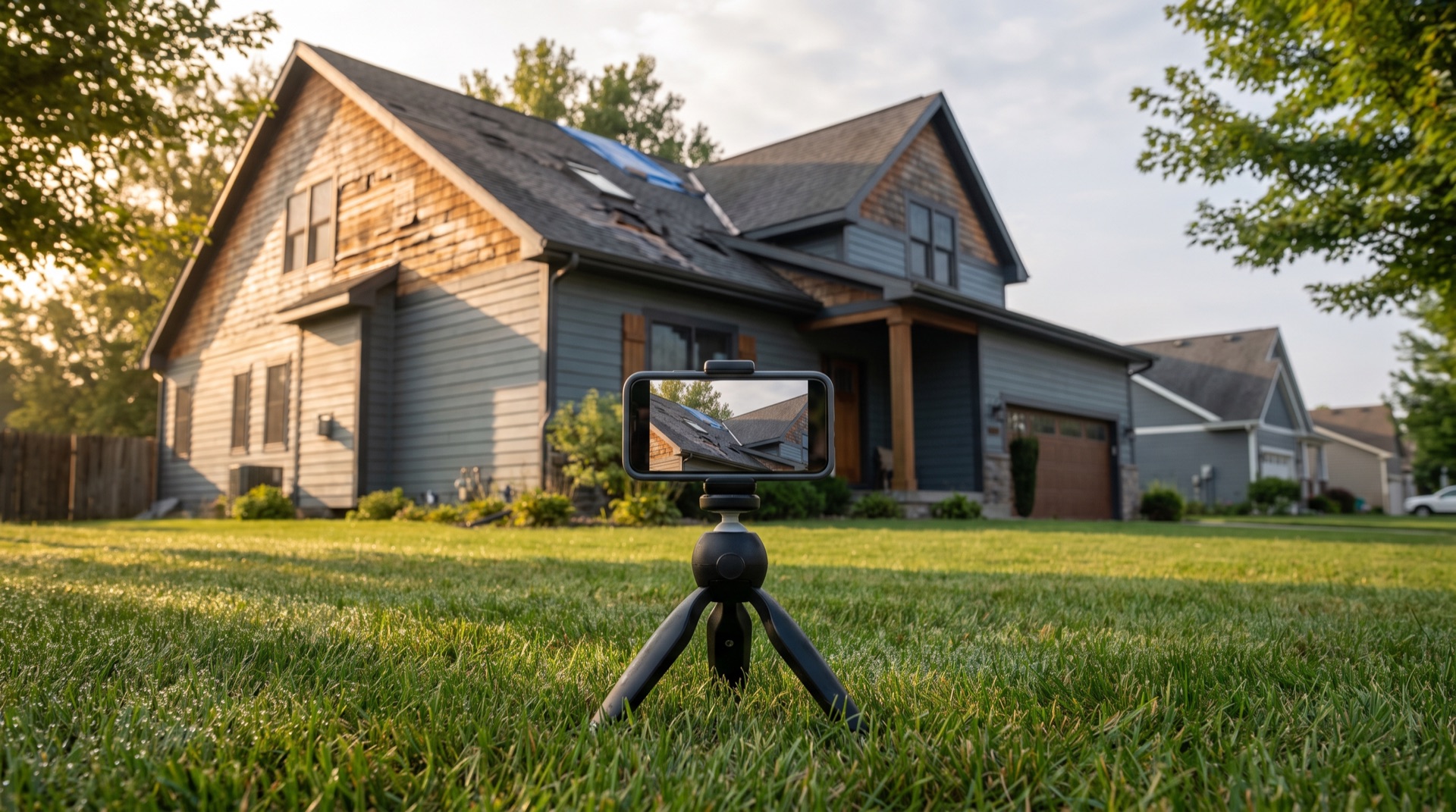
Note the date and the weather event. Photograph interior stains, damp insulation and anything on the floor under a leak. If you have older photos of the roof from a listing, a home inspection or a family picture in the yard, pull them out; the NAIC tells homeowners preparing for the adjuster to "gather any photos or videos of your home and property before they were damaged."
The reason for doing this first is simple. A tarp, a patch and a cleanup all destroy the record of what happened, and the record is what the claim is decided on.
Step 2: Read your own policy before you call
Two numbers on your declarations page shape everything that follows.
Your deductible. The NAIC defines it as "the part (or amount) of the claim you're responsible for," and says to find it out before you report damage, since "if the damage is minor, for example, just a few shingles were damaged, you might decide you're better off paying for the repairs out of pocket instead of filing an insurance claim."
Deductibles are not all flat dollar amounts. The NAIC's worked comparison shows a $250,000 home with a $500 flat deductible settling at $249,500 on a total loss, and the same home with a 2% deductible settling at $245,000, because 2% of $250,000 is $5,000. It also notes that "some insurance policies have a special deductible for losses caused by wind, hurricanes, or other types of storms," and that "some policies also may have a special deductible that applies to a specific part of your home, like your roof."
Your settlement basis. Replacement cost and actual cash value are not the same deal. The NAIC explains that replacement cost coverage "will pay the cost to repair or replace your damaged property without deducting for depreciation," while actual cash value coverage "will pay the depreciated cost." On an older roof that gap is large: the NAIC's Post-Disaster Claims Guide says that for a 20-year-old roof an ACV policy "may pay as little as 20% of the cost to replace the roof, since the useful life of a roof is usually about 25 years." The same guide warns that even under a replacement cost policy, "in some cases, the policy may pay ACV on your roof, but RCV on the rest of your home and property."
Neither number tells you what will happen with your claim. They tell you what you are working with before you pick up the phone.
Step 3: Call your insurer yourself, and write everything down
The NAIC says "the easiest way to report damage is to call your insurance company or agent directly," and to do it "as soon as you know there's damage and you decide to file a claim." Have your policy number if you can find it; if you cannot, your name, address and phone number are enough for them to locate the policy. Be ready to describe what happened and the extent of the damage, and to say that you have photos and video.
The NAIC publishes the list of things to ask on that call. Worth writing down and working through:
| What to ask | Why it matters later |
|---|---|
| The name and phone number of every person you speak to | The NAIC's guide has a page for logging exactly this |
| Your claim or reference number | Every later conversation starts with it |
| How long you have to file a claim | Deadlines come from your policy and your state |
| Whether you need repair estimates before you can file | Decides whether you are waiting on a roofer at all |
| A general idea of what your policy covers | Sets expectations before the adjuster arrives |
| Whether there are separate deductibles for hail, hurricane or wind | This is where the surprise usually lives |
| When you can expect an adjuster to call | The NAIC calls 3 to 5 days reasonable for a minor claim, longer after a large disaster |
Keep taking notes after the call too. The NAIC's consumer guide asks homeowners to "jot down notes and keep track of the dates of any conversations you have with your insurance agent or adjuster."
Step 4: Prevent more damage, and keep every receipt
You have a duty here, and it is in the policy. The NAIC's consumer guide states it plainly: "You're also required to protect your home from further damage."
The post-disaster guide gets specific for roofs: "Try to prevent further damage by making essential repairs, like covering roofs, or windows with plywood, tarp, canvas, or other waterproof materials." Then, in capitals: "KEEP ALL RECEIPTS FOR EMERGENCY REPAIRS TO GIVE TO YOUR INSURANCE COMPANY."
The line to hold is between emergency and permanent. Tarping a hole is emergency work. Replacing the roof is not. The NAIC's warning about permanent repairs before the insurer has seen the damage is the one most worth remembering, because a company "may not pay for repairs it didn't authorize."
If you cannot stay in the house, save the hotel receipts as well. Additional living expense coverage reimburses costs above your normal ones while the home is unlivable, and the NAIC notes that the coverage is limited: "Some policies have a dollar limit; some also may have a time limitation."
Your first two moves
These are sequential, not alternatives. Neither costs anything.
Meeting the adjuster
An adjuster is, in the NAIC's words, "a person who determines the amount of damage to your home and property—what can be repaired or replaced, and at what cost." A company adjuster works for your insurer; an independent adjuster is brought in by insurers when their own are stretched, often after a widespread storm. You pay neither of them.
The NAIC's preparation list for the visit is short: lists of the damage, any photos or video from before the damage, receipts where you have them, and, if you have had time, written bids from contractors. On the bids it is explicit that "you aren't required to have bids, but it can help," and that a useful bid "should detail the materials to be used, prices of those materials, and labor on a line-by-line basis."
Be there when the adjuster comes. Show them what you have found, take notes, get their name and contact details, and ask what happens next and when you will hear back.
A public adjuster is a third kind: someone you hire to handle the claim for you. The NAIC notes they "have no ties to the insurance company," that many states license them and some states prohibit them from negotiating claims, and that "you have to pay a public adjuster," either a flat fee or a percentage of the settlement, capped by law in some states. The insurer still sends its own adjuster regardless, and "doesn't have to accept your public adjuster's estimates."
What a contractor may and may not do with your claim
This is where state law does real work, and where the pages selling you a roof are quietest.
In Texas a roofing company doing the work cannot file or negotiate your claim; elsewhere the line is drawn differently. The Texas Department of Insurance states the rule for its state on roofing and insurance: Texas "doesn't allow a roofer or contractor to act as a public insurance adjuster on insurance claims if they're also doing the work." Among the practices it lists as improper are "offering to negotiate claim settlements or file a claim for the policyholder" and telling insurers that the contractor represents the policyholder. Texas also makes it illegal "for a contractor to offer to waive, rebate, or absorb a property policyholder's deductible," and requires contracts for $1,000 or more that involve an insurance settlement to carry notice that the policyholder must pay it. Other states draw these lines differently or not at all, which is exactly why the answer has to come from your own state's insurance department.
Then there is assignment of benefits. The NAIC describes an AOB as an agreement that "transfers your rights under your insurance policy and your claim to a third party, most often your contractor," and its caution is unusually pointed: "Typically, there's a promise from the contractor to handle all matters with the insurance company for you, which may sound great. But you also may be giving up some, most, or even all of your rights, including having a lawsuit filed without your approval or knowledge." Washington's insurance commissioner adds that once an AOB is signed, "the insurance company only communicates with the third party," that such contracts "usually don't include a right of recession or a cooling-off period," and, plainly: "You are not required to enter an AOB with a third party to have repairs done; you can file a claim directly with your insurance company."
The NAIC's own wording is that "some states allow assignments of benefits (AOB) after a loss." Whether one is permitted where you live, and what it would cost you, is a question for your state insurance department or an attorney, not for the person holding the contract.
If the offer is lower than you expected
Settlements arrive in pieces rather than in one lump sum, and the NAIC is candid that a large claim takes time: "most people find it takes at least 18 to 24 months to repair/rebuild their home and replace their possessions after a major disaster."
If your policy is replacement cost, the first payment may only be the actual cash value. The NAIC explains that when you "present evidence that the damaged property has been repaired or replaced, the insurer will pay the difference," known as recoverable depreciation, and that there is usually a time limit on claiming it, one that "can range from 6 months to up to one year, depending on your state's laws and your policy." Ask your adjuster what yours is rather than discovering it later.
If you disagree with the amount, the NAIC's steps are: call the insurer and explain why you think the offer is unfair, ask for any denial in writing, keep all the paperwork, and contact your state insurance department if that does not resolve it. Your policy may also have an appraisal clause, a process that "only determines costs, not if your policy covers these costs," and that you must go through before suing if the clause is there. Your state insurance department helps with this free of charge.
Bottom line
Document, read, call, mitigate. In that order, and all of it before you sign anything with a contractor. Knowing your deductible and your settlement basis before the first phone call is what turns a claim from something happening to you into something you are running. When the repair itself is on the table, the roof replacement guide covers scope, quotes and choosing a roofer, and your state insurance department will answer questions about deadlines, adjusters and assignment of benefits for nothing.
Before the adjuster comes, actual cash value against replacement cost explains what will decide the amount. If the answer comes back as a denial, the free routes first sets out what to do next.
Common questions
What is the first thing to do after roof damage?
Make sure the property is safe, then photograph and video the damage before anything is moved, covered or repaired. The NAIC's Post-Disaster Claims Guide puts photos and notes in the first set of steps, before the call to the insurer.
How long do I have to file a roof insurance claim?
Your own policy and your state's law set that limit, and there is no single national answer. The NAIC lists "How long you have to file a claim" as one of the questions to ask on the call, and your own policy and your state insurance department are the places to confirm it.
Do I need a roofer to meet the adjuster?
No. The NAIC's consumer guide mentions a contractor meeting you and the adjuster as something that might help if you and the insurer disagree, not as a required step. You may invite one, and you may also meet the adjuster on your own.
Can a roofing contractor file the claim for me?
The rules on how far a contractor may go vary by state. Texas, for example, does not allow a roofer who is also doing the work to act as a public insurance adjuster on the claim, and lists offering to file a claim for the policyholder among the practices it treats as improper. Elsewhere the line is drawn differently, so ask your state insurance department.
Should I sign an assignment of benefits?
That is your decision, and it is worth reading closely first. The NAIC warns that an assignment of benefits transfers your rights under the policy to a third party and that you may be giving up some, most or even all of them; Washington's insurance commissioner notes you are not required to sign one to get repairs done.
What if the settlement offer seems too low?
The NAIC says to call the insurance company and explain why you think the offer is unfair, to ask for any denial in writing, and to contact your state insurance department if the response does not satisfy you. Your policy may also contain an appraisal clause for disagreements about cost.
Sources
- NAIC: Post-Disaster Claims Guide
- NAIC: A Consumer's Guide to Home Insurance
- NAIC: Rebuilding After a Storm — Replacement Cost vs. Actual Cash Value
- Texas Department of Insurance: Roofing and insurance — know the law
- Washington Office of the Insurance Commissioner: Caution on assignment of benefits
- FTC Consumer Advice: How To Avoid Scams After Weather Emergencies and Natural Disasters
By RoofWise USA Editorial Team. First published September 17, 2026. Advertiser disclosure