Guide
What Does Hail Damage Look Like on a Roof, and What Doesn't
How to spot hail damage on a roof from the ground, and how to tell it apart from blistering, ordinary granule loss, factory defects and foot traffic.
Updated September 17, 202611 min readReviewed by RoofWise USA Editorial Team, editorial review: primary sources checked and independently fact-checked
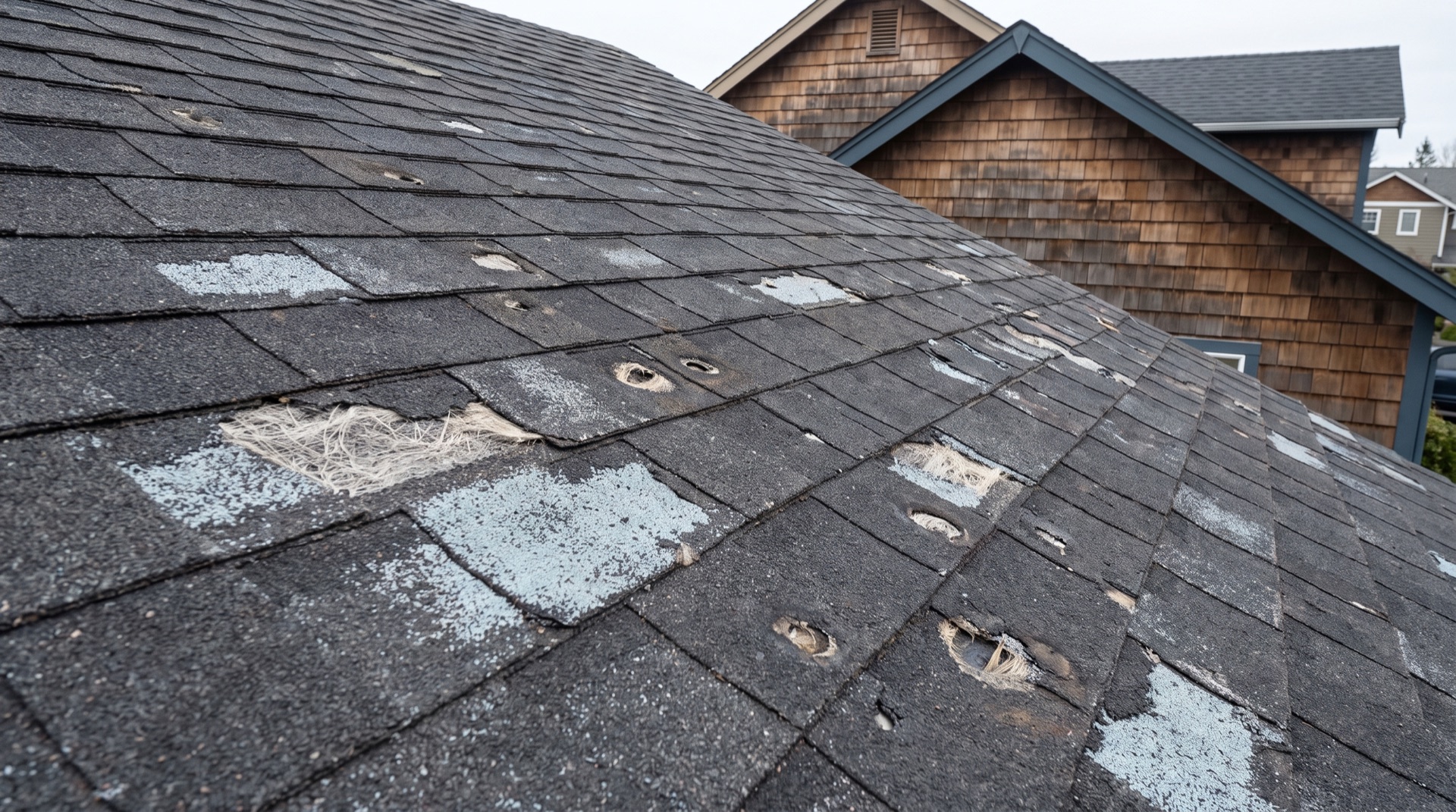
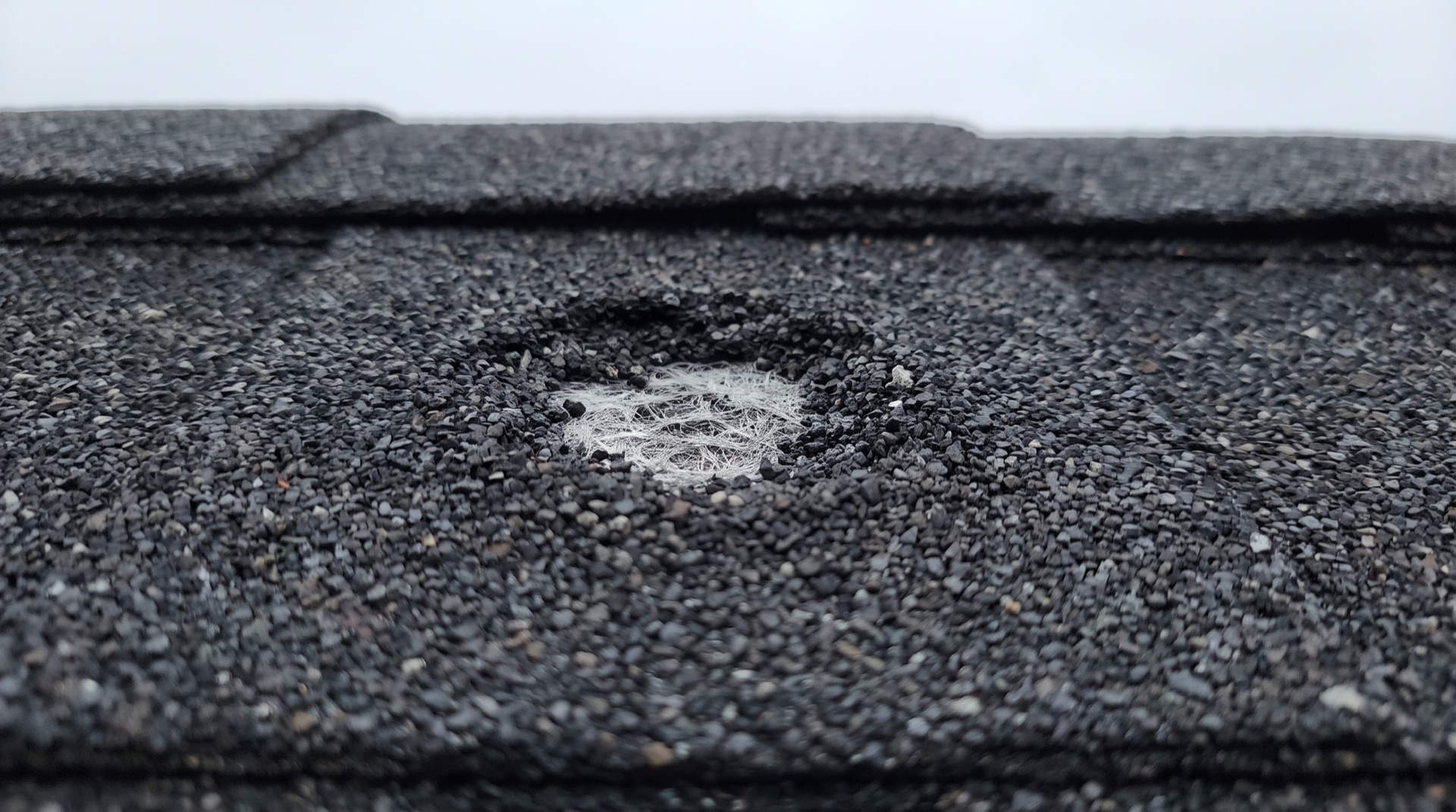
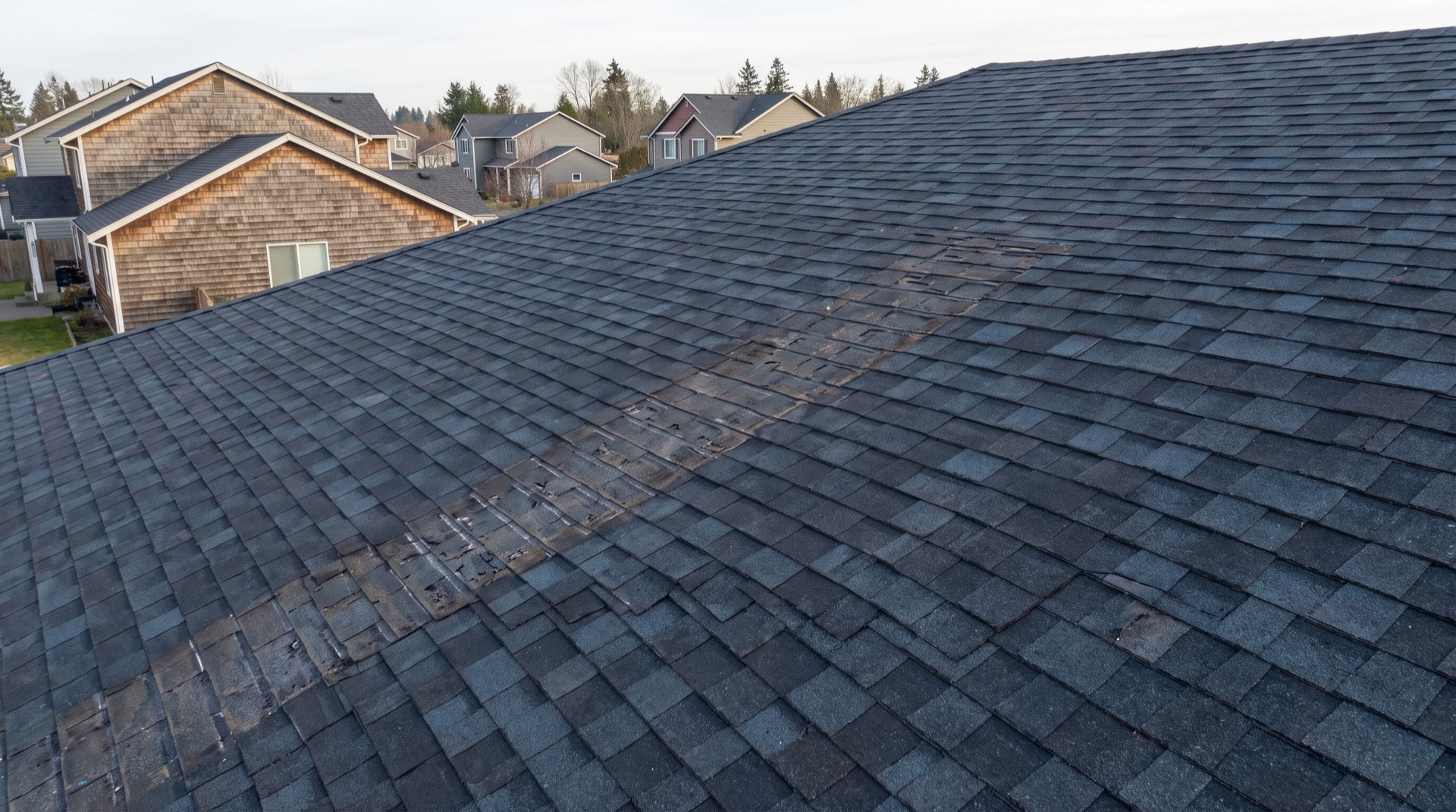
Hail damage on an asphalt roof looks like scattered dark spots where the surface granules have been knocked away, often with a shallow dent in the middle and sometimes a split in the shingle itself. It lands at random, with no pattern, across whichever slopes faced the storm. The harder part is what this page spends most of its time on: four other things that look almost identical from the ground and get sold to homeowners as hail damage every season.
What hail damage actually looks like on asphalt shingles
An asphalt shingle is a stack. IBHS describes it in Roof 101 as granules, which are "coated rocks that protect the fiberglass from damaging UV rays," over asphalt, which is "the main water-shedding ingredient in shingles," over a fiberglass mat, with a sealant strip that bonds each course to the one below. Hail does its damage by disturbing that stack, which is why the signs are specific rather than general.
IBHS quantifies the result in its impact resistance test protocol as five defined damage modes. Those are laboratory measurements on test samples, but three of the modes name the marks worth looking for on your own roof:
Deformation. A dent is defined as "negative local deformation where volume is compressed below the flat shingle plane," and it usually comes with a ridge of dent, "positive local deformation where volume is raised above the flat shingle plane." In plain terms: a small crater with a slightly raised rim. From the ground or a window, that reads as a soft, bruised circle sitting slightly below the surface around it.
Granule loss. IBHS separates patch granule loss, "clusters of granules missing that result in exposed asphalt and/or fibers," from individual granule loss, "single or many granules missing that are not clustered." The patch kind is what you can actually see from a distance: a dark spot against the lighter granule color, because the asphalt underneath is exposed.
Breach. Defined as damage "caused by a tear, rupture, or crack." This is the one that matters most for water, and it is the least visible from the ground.
The pattern is as diagnostic as the marks. Hail arrives from one direction and hits everything on that side, so damage appears on the slopes that faced the storm, spread randomly rather than in lines, and it lands on hard and soft surfaces alike. If the marks follow a path, cluster around a vent, or appear only where a person would stand, hail is not the first explanation.
Look at the soft metal before you look at the roof
The first evidence of a hailstorm is usually at eye level, on metal thin enough to take a permanent dent at an energy a shingle can absorb. The walk-around that follows is our own practical guidance for looking from the ground, not a finding of IBHS, the National Weather Service or any regulator.
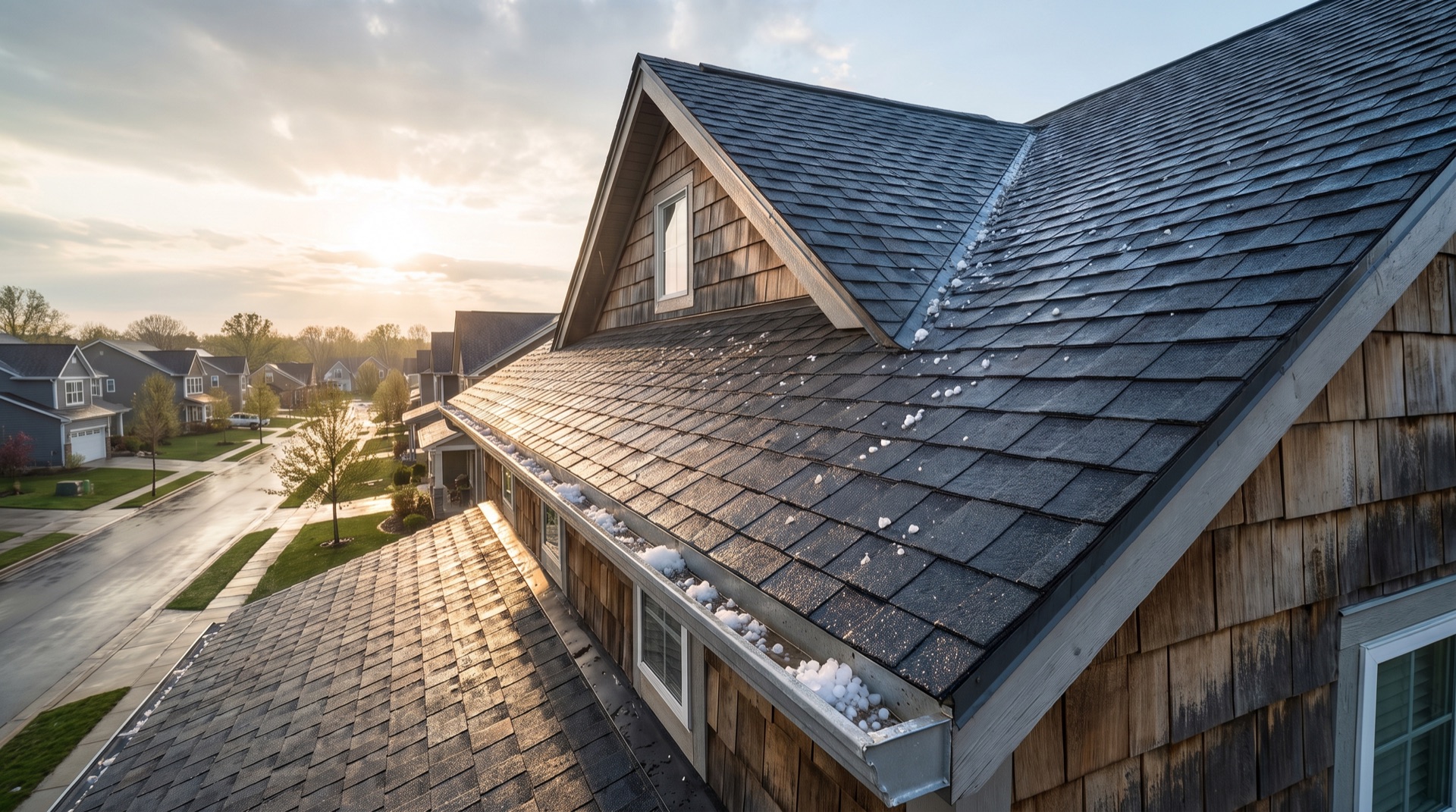
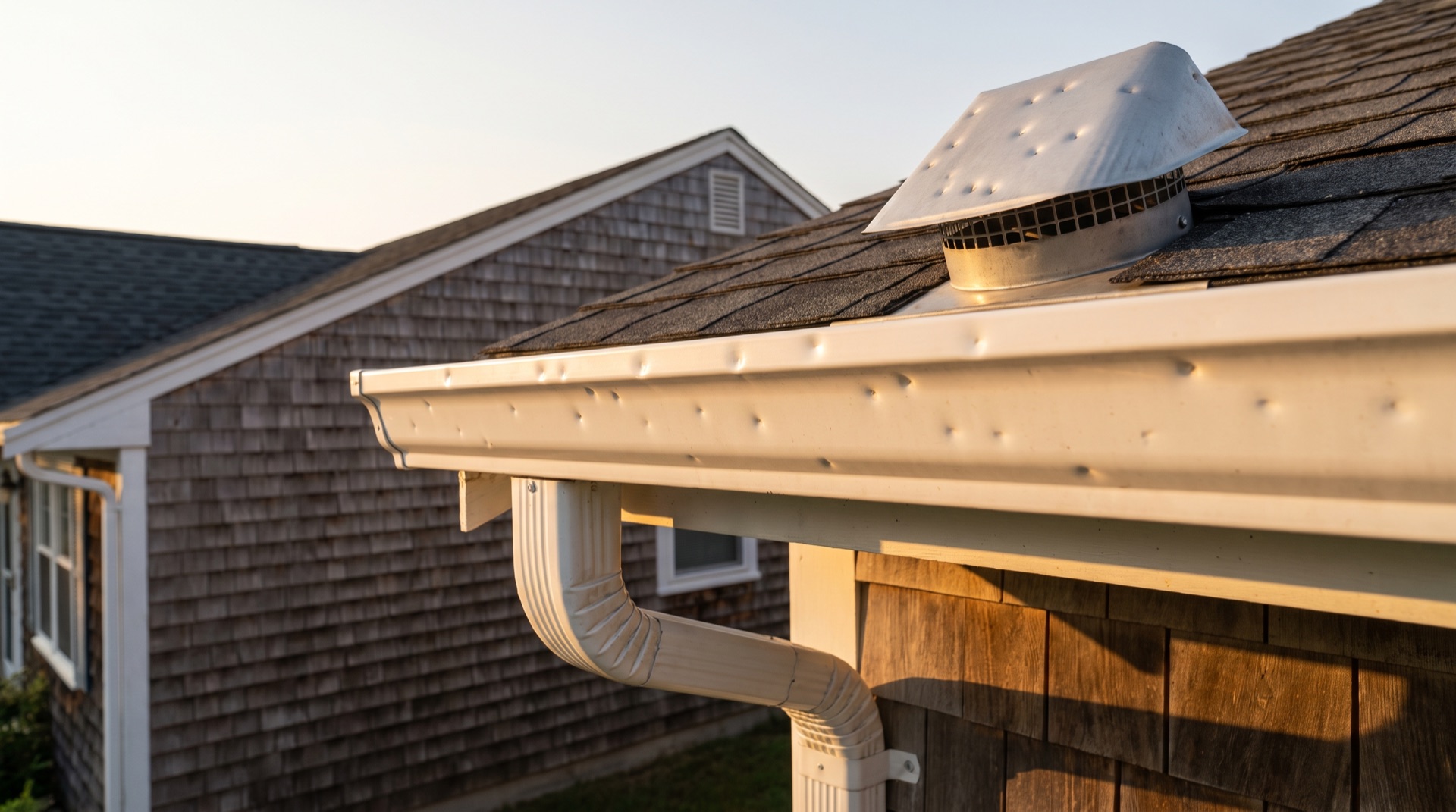
Walk the perimeter and look at the gutters, the downspouts, the gutter apron and drip edge, the metal vent caps and turbine hoods, the flashing at chimneys and valleys, the fins on the outdoor air conditioner unit, the window wraps and screens, the garage door panels, the mailbox and the lid of a metal grill. Fresh dents are bright inside because the finish is disturbed, and they sit at random rather than in rows.
Two things make this worth doing first. Dents on soft metal are unambiguous in a way that a mark on an asphalt shingle rarely is, and they date themselves: if the gutters were straight in a photograph from last spring, the hits are newer than that. They also point to the slopes worth examining, because the metal takes the hits on the same side the roof does.
Knowing whether hail was actually reported near you is the other half of this, and it is something you can establish before anyone visits.
What it looks like on metal and tile roofs
IBHS describes the other common coverings in Roof 101: metal roofs, most often steel, with aluminum, copper and zinc also used, and tile roofs made from clay or concrete in low, medium and high profiles. That is the material list; how hail tends to present on each, below, is our own practical guidance rather than something IBHS tests for.
On a metal roof, hail leaves dimples and dents in the flat of the panel, usually shallow and round, most visible in low, raking light. Denting and leaking are different questions, and a dented panel may still shed water perfectly well. Whether a dent that costs the roof nothing in function is covered at all is a question only your own policy language answers, so read it rather than assume either way. The parts of a metal roof worth checking most closely are the ones that are not the panel: ridge caps, vent flashing, exposed fasteners and their washers.
On a tile roof, hail cracks and chips rather than dents. Look for hairline cracks running across the face of a tile, chipped corners and broken noses along the exposed edge, and fragments of clay or concrete sitting in the gutters or on the ground below the eaves. Tiles are also the covering most easily broken by someone walking the roof, which is a reason to treat a stranger's offer of a free look with some care and a reason to stay off it yourself.
The four things that get sold to homeowners as hail damage
This is the part the ranking pages skip, and it cuts both ways. A homeowner who cannot tell these apart may miss real damage, or may be talked into a claim for something a storm never caused. Where IBHS is quoted below the quote does the work; the descriptions of how each look-alike presents are our own practical guidance rather than findings of any authority.
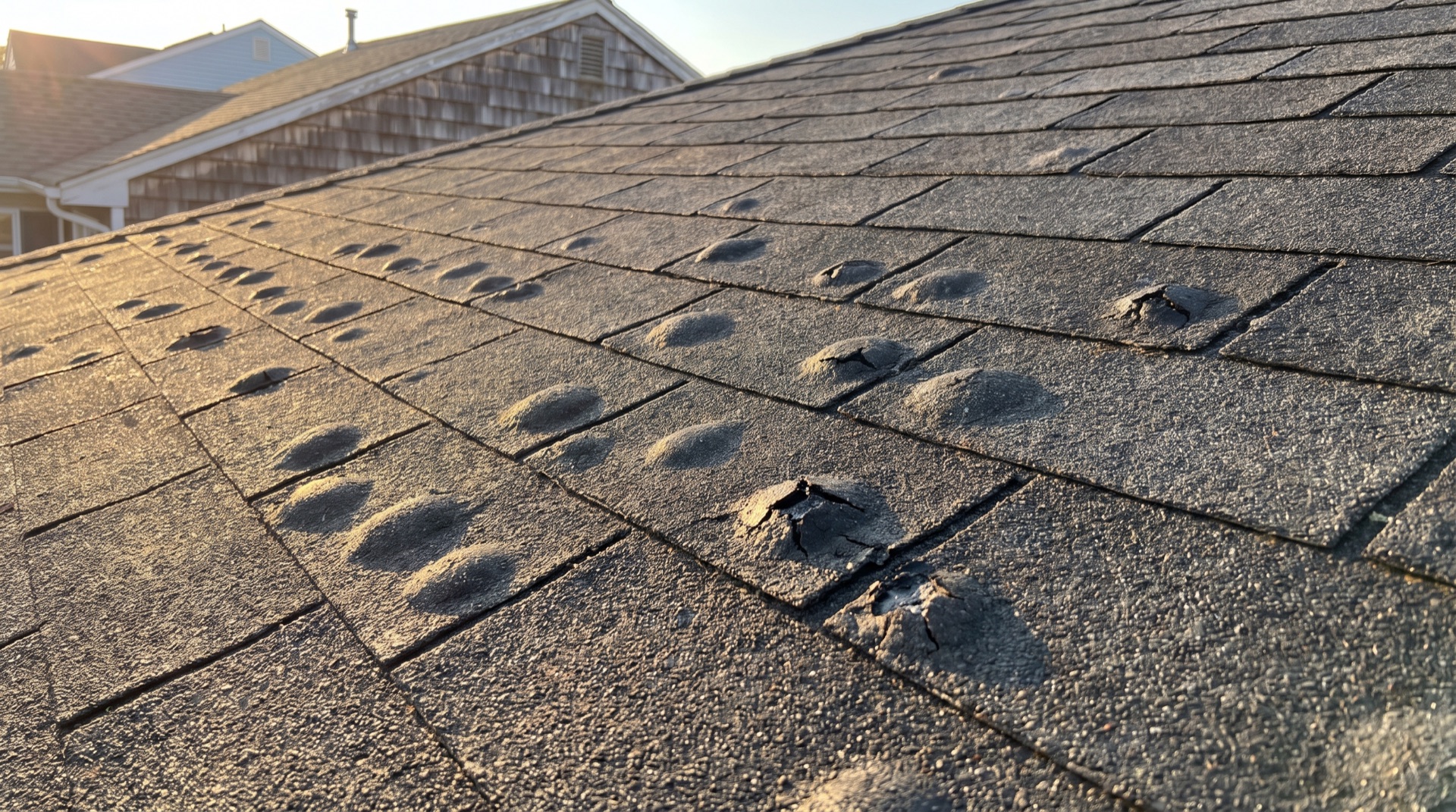
Blistering. Blisters are small round craters in the shingle surface, formed as trapped moisture or volatile compounds expand under heat. Once a blister opens it exposes asphalt and looks remarkably like a hail bruise. The differences are in the shape and the distribution: blisters are evenly sized and evenly spread over a whole slope, they have clean round edges with no raised ridge around them, and they favor the hottest, most sun-exposed slopes regardless of which direction a storm came from. Hail is directional and irregular. IBHS never names blistering, but its test method excludes this whole class of change generically, stating that "effects of weathering, temperature, aging, product variability, roof system configuration and application, or similar effects are outside the scope of this test method."
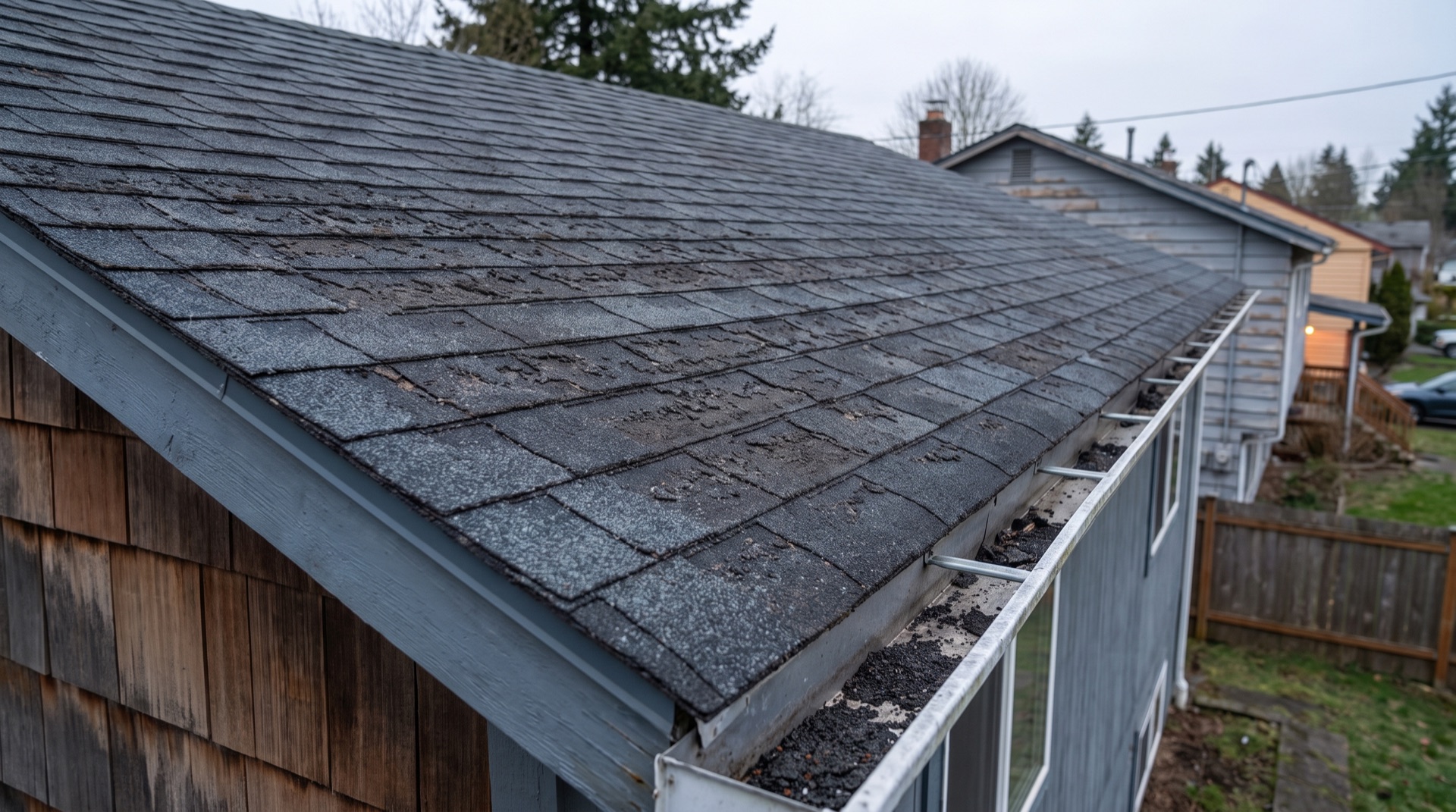
Ordinary granule loss from aging. This is the most commonly mis-sold sign of all, because granules in the gutter feel like proof of something. IBHS does call granule loss "one of the most frequent results of hail impact damage to asphalt shingles," so it is a real signal and not one to dismiss. The same passage, though, says "there are no set criteria for how much granule loss is considered to be acceptable for the roof to still function," and that "some manufacturers apply excess granules during manufacturing, so some loss is considered a normal part of natural weathering." Granules in the gutter are therefore consistent with a hailstorm and equally consistent with an old roof. What separates them, in our experience, is the pattern: age-related loss thins the surface evenly and shows up worst below valleys and downspout outlets where water concentrates, while hail-related loss is patchy, sits in discrete spots, and is often centered on a dent.
Manufacturing and installation defects. Shingles can arrive or be installed with problems that look like impact marks: nails driven through the exposed face, over- or under-driven fasteners, factory flaws in the mat. IBHS treats these as a separate category, stating its method "is also not applicable for evaluating damaged or defectively manufactured products." Defects tend to repeat in a regular geometry, because manufacturing and nailing are regular processes. Hail does not repeat at intervals.
Foot traffic and mechanical damage. Anything that has been on your roof leaves marks: a roofer, a satellite installer, a chimney sweep, a fallen branch, a tree rubbing a slope in wind. Traffic damage is scuffed rather than bruised, it runs in paths between access points and work areas, and it concentrates near the eave where a ladder lands. Hail has no reason to follow a route.
Does hail size tell you what to expect?
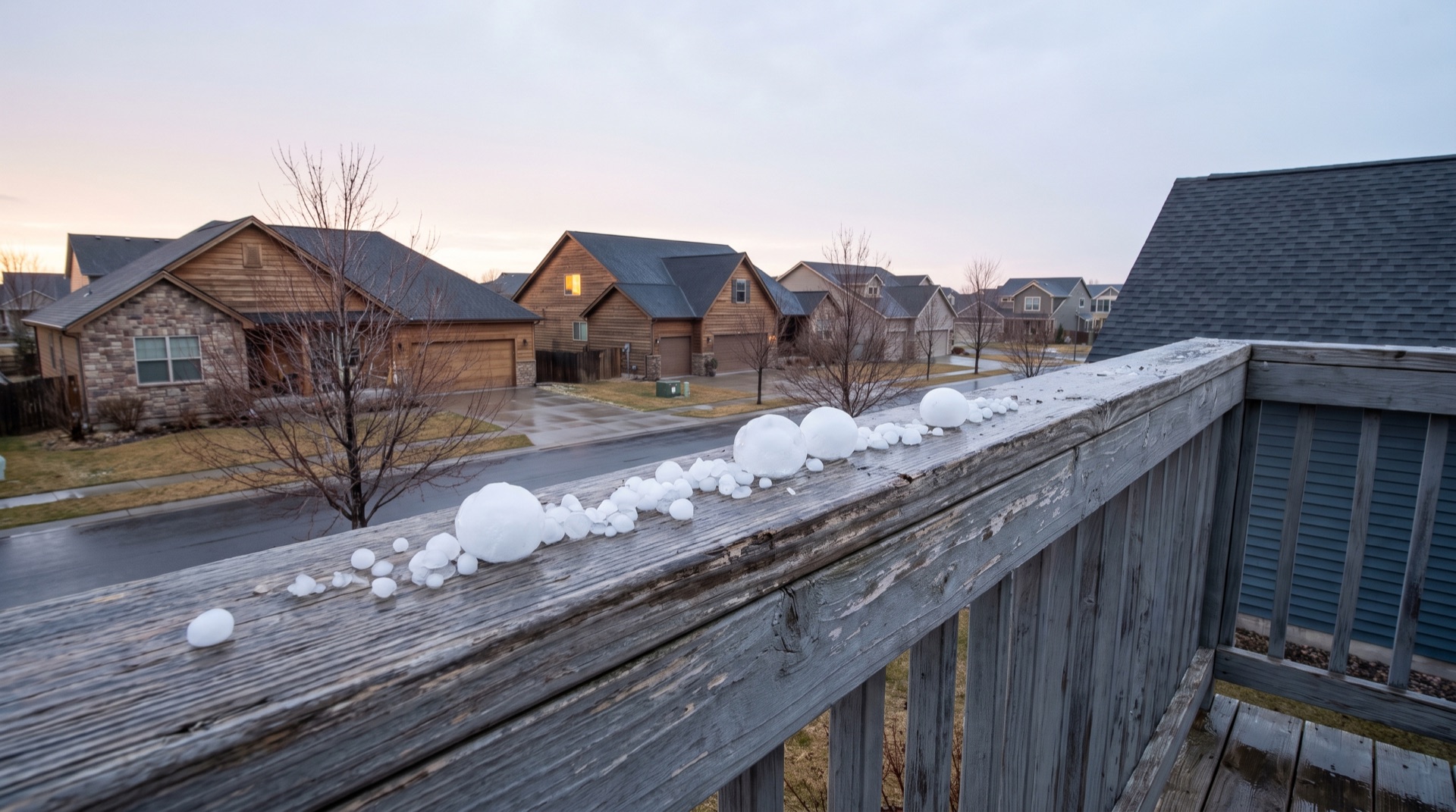
Partly, and less than most pages imply. The National Weather Service's guidance on estimating hail size puts the severe thunderstorm criterion at 1 inch in diameter, quarter size, and uses familiar objects as the reference scale, from pea at a quarter inch up to softball at four and a half. Separately, the NWS tags severe thunderstorm warnings by damage threat, with a considerable tag for "at least 1.75 inch diameter (golf ball-sized) hail and/or 70 mph thunderstorm winds" and a destructive tag for "at least 2.75 inch diameter (baseball-sized) hail and/or 80 mph thunderstorm winds." Those tags govern how a warning is communicated, including which ones trigger a wireless emergency alert on phones in the warned area. They are not roof-damage thresholds, and either can be met on winds alone.
For shingles specifically, IBHS runs its impact resistance research using "1.5- and 2.0-inch diameter laboratory manufactured hailstones," which is a reasonable indication of the sizes that separate products in a controlled test.
What size does not do is settle your roof. IBHS is careful that its results allow products to be compared with each other but do not transfer directly to a particular house or a particular storm, and it lists weathering, temperature at the time of impact and product variability as variables it has not tested for. Wind driving hail sideways, the angle of your slopes, the age and brittleness of the covering and whether the shingles had sealed all change the outcome.
What to do with what you find
Start with the option that costs nothing and keeps every other one open.
Photograph what you can see from the ground and from windows, including the soft-metal dents, and note the date of the storm. Keep anything that establishes the roof's condition beforehand, such as an older listing photo or a home inspection report, because the question that eventually gets asked is what changed and when.
If a claim follows, the number that decides the money is not the damage but the settlement basis. The National Association of Insurance Commissioners explains the two: replacement cost coverage "will pay the cost to repair or replace your damaged property without deducting for depreciation," while actual cash value "will pay the depreciated cost to repair or replace your damaged property." The NAIC's worked example has two families with identical $15,000 of roof damage and $1,000 deductibles; one receives $14,000 and the other $4,000 after $10,000 of depreciation. The NAIC also notes that some policies carry a special deductible for parts of the home such as the roof, and defines a deductible as "the part (or amount) of the claim you will have to pay out of pocket."
Bottom line
Real hail damage on asphalt is a random scatter of bruised, granule-stripped spots on the slopes that faced the storm, with dents in the soft metal at ground level to corroborate it. Blistering is evenly spaced and heat-driven, age-related granule loss is even and worst where water runs, defects repeat in a pattern, and foot traffic follows a path. If what you see looks like hail, document it from the ground, check whether hail was actually reported near you, and let an adjuster and a licensed roofer make the call. If you get that far, the roof replacement guide covers what the work involves and how to compare bids without being rushed.
For what to do in the first days after a storm, see the hail-damage walkthrough. For why the size of the stone is only part of the answer, read what size hail damages a roof.
Common questions
What does hail damage look like on a roof from the ground?
Scattered dark spots where granules have been knocked off, often with a shallow dent in the middle, landing at random with no pattern and no relation to where anyone walks. Dents, granule loss and tears are what to photograph, but whether they add up to a claim is an adjuster's call.
Can I tell hail damage from blistering myself?
Often, yes, from the general shape. Blisters are round, evenly spaced craters that form as the shingle ages, and they tend to appear on the hottest slopes whether or not a storm passed. Hail lands at random across whichever slopes faced the storm.
Is granule loss on its own hail damage?
Not on its own, in either direction. IBHS calls granule loss one of the most frequent results of hail impact damage to asphalt shingles, and in the same passage notes that some manufacturers apply excess granules, that some loss is a normal part of natural weathering, and that there are no set criteria for how much loss still lets a roof function.
Where should I look first after a hailstorm?
The soft metal at ground level: gutters, downspouts, gutter aprons, vent caps, window wraps and air conditioner fins. Thin metal records a hit that a shingle may hide, and you can see all of it without leaving the ground.
What size hail damages a roof?
There is no single threshold. The National Weather Service treats 1 inch, quarter size, as the severe thunderstorm criterion, and IBHS tests shingles with 1.5 and 2.0 inch laboratory hailstones, but the outcome on your roof also depends on wind, impact angle, material and age.
Who decides whether my roof has hail damage?
Your insurer's adjuster, under your policy, with a licensed roofing professional's inspection as input. No page, no app and nobody at your door can make that determination.
Sources
- IBHS: Impact Resistance Test Protocol for Asphalt Shingles
- IBHS: Relative Hail Impact Resistance of Asphalt Shingles
- IBHS: Roof 101
- NOAA National Weather Service: Estimating Winds and Hail Size in Thunderstorms
- NOAA National Weather Service: Severe Thunderstorm Warning Damage Threat Tags
- NAIC: Rebuilding After a Storm — Replacement Cost vs. Actual Cash Value
- FTC Consumer Advice: How To Avoid Scams After Weather Emergencies and Natural Disasters
By RoofWise USA Editorial Team. First published September 17, 2026. Advertiser disclosure