Guide
What Size Hail Will Damage a Roof? What Testing Shows
No single hail size damages every roof. What lab testing shows about hail size, shingle impact rating, roof age and where the stone lands.
Updated September 17, 202610 min readReviewed by RoofWise USA Editorial Team, editorial review: primary sources checked and independently fact-checked
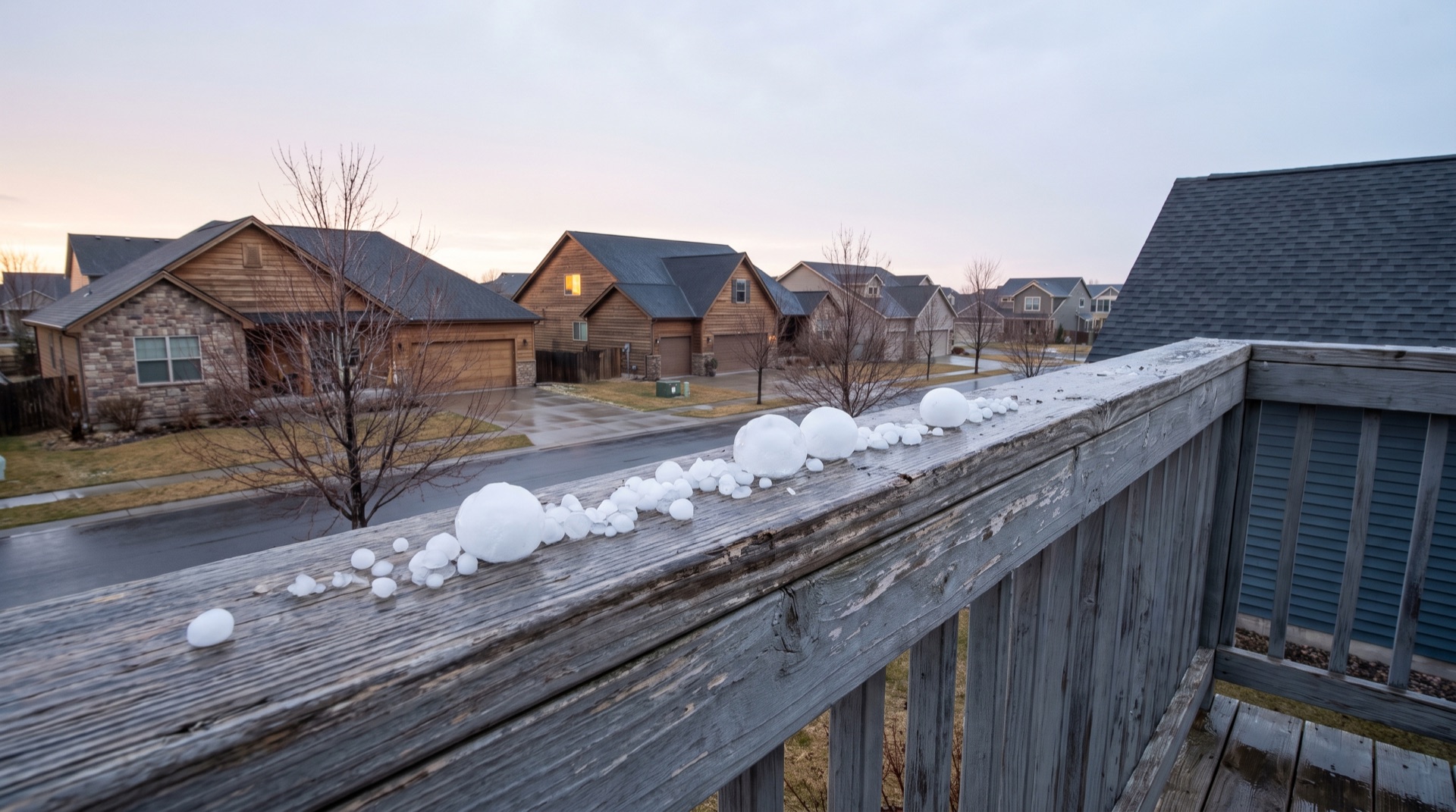
What size hail will damage a roof depends less on the stone than on what it hits. In its UL 2218 lab testing, the Insurance Institute for Business & Home Safety (IBHS) found that ordinary asphalt shingles already failed at some impact locations under the smallest test projectile, 1.25 inches, while impact-rated products survived 2.00-inch impacts at many locations and still failed at others. Size is one of four things that decide the answer. The other three are the shingle's own impact rating, how old and weathered it is, and where on the roof the stone happens to land.
Is 1 inch really the number?
Almost every page that ranks for this question gives you one inch, without saying where it came from. Here is where it came from: the National Weather Service uses 1 inch of hail as one of the three criteria for calling a thunderstorm severe. The others are a tornado and "winds of at least 58 mph". It is a forecasting and warning threshold. Nobody derived it from shingle testing, and the NWS does not present it as a damage threshold for roofs.
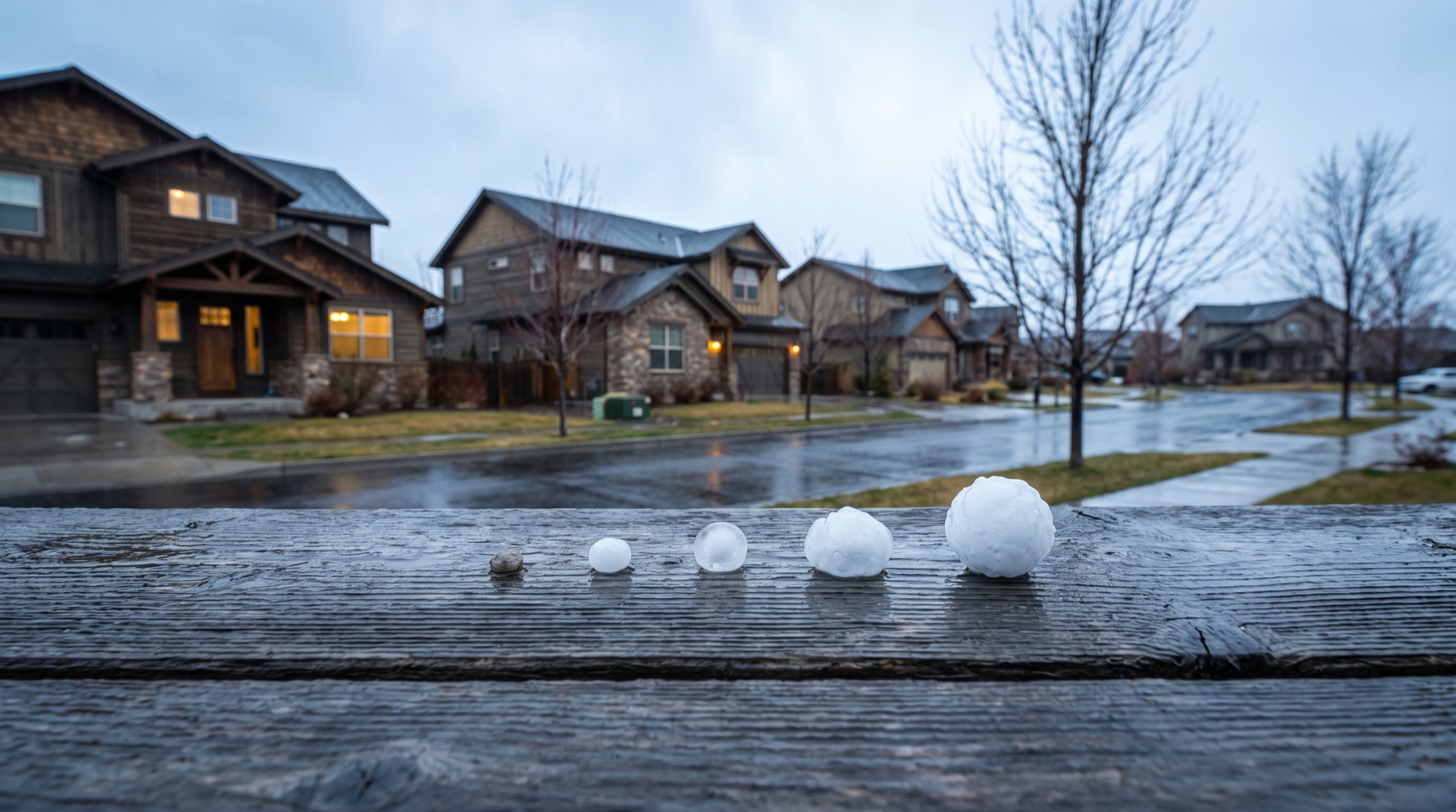
It is still useful, because hail reports are recorded in those terms. The NOAA Storm Prediction Center publishes the object comparison table that spotters and the public use when they call a report in:
| Reported as | Diameter |
|---|---|
| Penny | 0.75 in |
| Quarter | 1.00 in |
| Half dollar | 1.25 in |
| Walnut or ping pong ball | 1.50 in |
| Golf ball | 1.75 in |
| Hen egg | 2.00 in |
| Tennis ball | 2.50 in |
| Baseball | 2.75 in |
Those sizes matter for a different reason than most people assume. They line up almost exactly with the sizes used in the impact standard that shingles are graded against.
What the impact classes actually mean
Impact-resistant shingles are graded by a steel ball drop test. IBHS describes the standard plainly in its summary of UL 2218 impact tests, published in August 2014: "The Class 1 projectile is 1.25 in. in diameter, Class 2 is 1.50 in., Class 3 is 1.75 in., and Class 4 is 2.00 in. in diameter. These steel balls are dropped from the height necessary to achieve the same kinetic energy a hailstone of the same size would have in a thunderstorm."
So a Class 4 shingle is one that passed a 2.00-inch test, roughly hen-egg hail. A Class 1 shingle passed at 1.25 inches, half-dollar hail.
Two things about that test are worth knowing before you read a rating as a shield.
First, what counts as failure is narrow. IBHS: "Any evidence of opening—tearing, fracturing, cracking, or rupturing—on the back of the shingle is recorded as a test failure." And then: "Crushed or dislodged granules, dents, or openings visible only on the top of the shingle, are not considered failures in UL 2218 performance criteria." A shingle can pass the test and still look, to you and to an adjuster, like it took a beating.

Second, IBHS says outright that the criteria are not an insurance yardstick: "Performance criteria used in this assessment do not necessarily reflect the performance criteria used by insurance companies in determining whether to repair or replace an asphalt shingle roof cover following a hail event."
More recently, IBHS moved past steel balls entirely. Its current hail impact work tests commercially available asphalt shingles "using both 1.5- and 2.0-inch diameter laboratory manufactured hailstones using the IBHS hail impact testing protocol", built on documentation of real hailstone size, density, strength and kinetic energy. Ice behaves differently from steel, which is the point.
The number the competitors never publish
IBHS tested 22 asphalt shingle products from five manufacturers and reported the share of impact locations that passed at each class size. These are the passing percentages labeled on the report's own charts:
| Shingle type | 1.25 in | 1.50 in | 1.75 in | 2.00 in |
|---|---|---|---|---|
| Basic 3-tab | 43% | 23% | 27% | 23% |
| Basic architectural | 55% | 42% | 33% | 32% |
| Impact-rated 3-tab | 67% | 75% | 58% | 58% |
| Impact-rated architectural | 77% | 71% | 60% | 41% |
One quirk worth flagging, since it is the kind of thing that makes two honest pages disagree: the report's narrative text rounds these figures differently from its own charts. The text says Class 1 impacts passed at "about 45 percent" of locations on basic 3-tab shingles, where the chart for the same comparison is labeled 43%. The table above uses the chart labels.
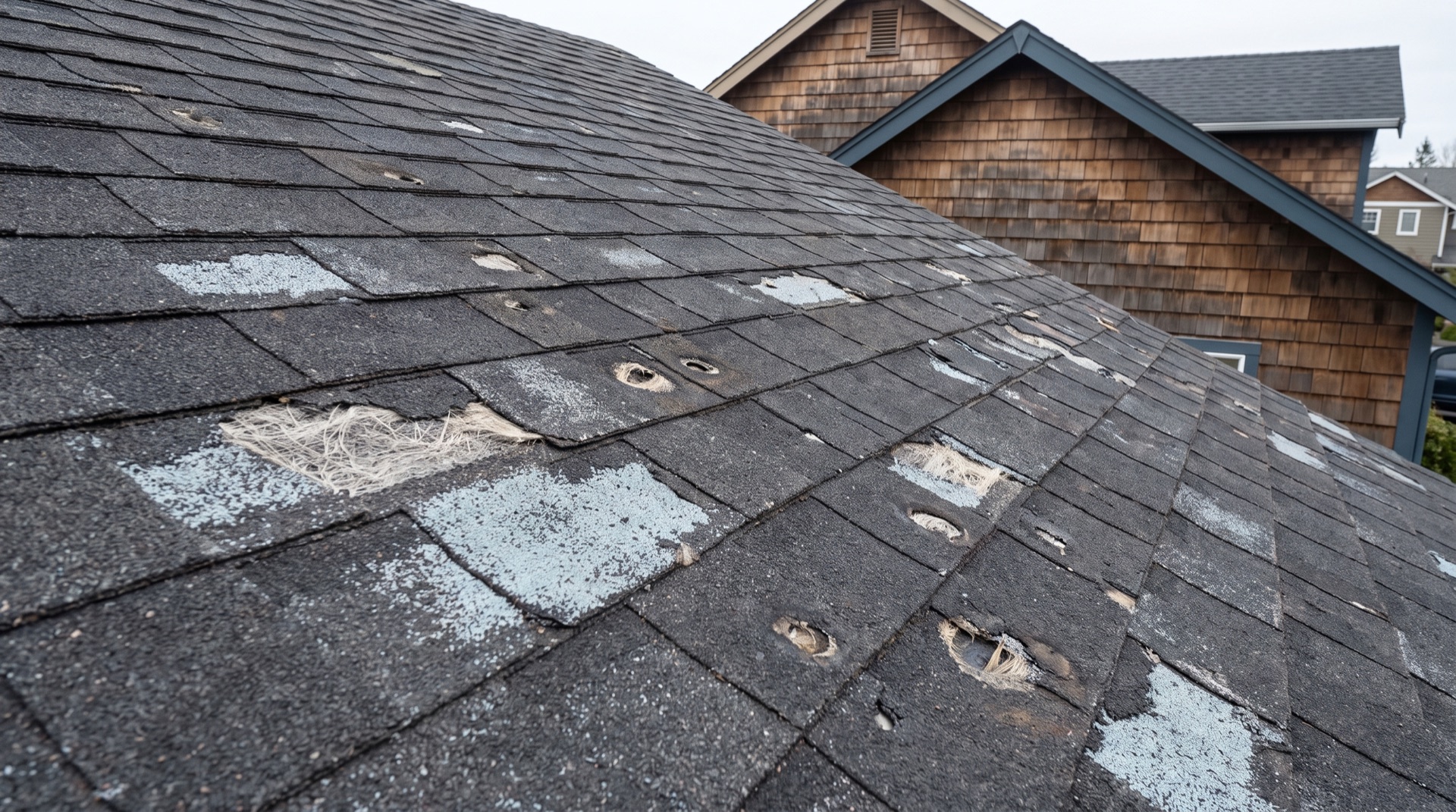
Read the top-left cell again. On a basic 3-tab roof, more than half the impact locations already failed at 1.25 inches, under a controlled drop, on a brand-new shingle installed to the manufacturer's instructions. That is the honest version of "what size hail will damage a roof": on a cheap, older covering, less than you have been told.
Read the right-hand column too. The impact-rated products are rated to withstand Class 4 impacts, and IBHS notes that they "should withstand testing without cracking or tearing on the shingle back for all four projectile sizes". They did not. IBHS states that "none of the products tested—basic or impact rated—passed more than Class 2 impacts without at least one double impact location failing the UL 2218 performance criteria."
An impact rating is a real, measurable improvement, and it is not a shield. Both of those are true at once.
Why age moves the number more than most people expect
This is the part the one-inch rule of thumb hides completely.
IBHS runs a short-term roof aging program that re-tests recently aged roofing materials with hail impacts "at 1- and 2-year intervals", to bridge "the gap between new and naturally aged roof performance". Separately, using the same hail impact protocol, IBHS reports that researchers "have identified asphalt shingle products that perform well against 2-inch, realistic laboratory-made ice hailstone impacts" — our own reading is that this is product identification on new material rather than a result from the interval re-tests, since IBHS reports the two separately. The aging work asks what happens after that, and IBHS hedges its answer as preliminary: "Early testing shows that natural short-term weathering can measurably reduce hail impact performance, and repeated hail exposure can accelerate this decline."
Then there is the small stuff. IBHS has separately tested high concentrations of small hail, meaning "sub-severe" stones under 1 inch, the kind that never triggers a warning and never gets reported. That hail "knocks away protective granules from asphalt shingles, exposing the underlying asphalt to sunlight and weathering—speeding up the aging process." And roofs that had taken both natural weathering and two simulated sub-severe events became "up to ten times more susceptible" to damage in a subsequent large-hail impact.
The practical consequence: the storm that damages your roof may not be the storm that ranks in the record. A roof can be worn down by years of hail too small to report, then opened up by a stone that would have bounced off it when it was new.
Where the stone lands, on the same roof
Damage across a roof is uneven, and IBHS measured one reason why. In its UL 2218 panels, "The most severe dents occurred for impacts along the 2 x 4 brace in the center of the panel, where the deck was stiffened and there was not much flexibility to respond to the impact. This area simulates where roof trusses or rafters would be located."
Same stone, same shingle, different result, depending on whether it hit over a rafter or over the span between them. Edges, corners and joints behaved differently again: IBHS recorded that flattening was "evident particularly at joints, corners, and edges."
This is why a hail size on its own cannot tell you what happened up there, and why a proper assessment goes slope by slope.
Finding out what actually fell where you live
Hail reports are logged with a size and a place. NOAA's Storm Events data format records hail magnitude "in inches to the hundredth" along with the latitude and longitude where the event began, which means you can check what was reported near you and when, rather than relying on somebody's memory or somebody's sales pitch.
Two honest limits on any hail report, yours included. The sizes are estimates against everyday objects unless someone put a ruler on a stone, and a report is tied to where the observer was, not to your roof. A report of golf-ball hail two miles away is a reason to look; it is not evidence about your covering.
Damage you can see, damage you cannot
Hail damage and a leak are not the same event, and they do not arrive together.
IBHS research on water leakage from hail-damaged shingles found "a clear relationship between the size of a dent and the water leakage rate": small dents produced negligible leakage, while large dents caused "quite large water leakage", and a tear severity approaching 1 on a 0 to 3 scale already allowed large amounts of water through.
So a roof can take real hail damage, lose granules and service life, and stay dry through the next several rainstorms. A dry ceiling is not evidence that nothing happened. It is also not evidence that something did.
What to do after a hailstorm, cheapest option first
If a claim is in play, two policy terms decide most of the money, and both are on your declarations page rather than on your roof. The National Association of Insurance Commissioners explains the first: replacement cost coverage "will pay the cost to repair or replace your damaged property without deducting for depreciation", while actual cash value coverage "will pay the depreciated cost". On a roof, where depreciation tracks age, that difference is large. The second is the deductible, which the NAIC describes as "the part (or amount) of the claim you will have to pay out of pocket", and it notes that some policies carry a separate deductible for wind or hail damage. Whether any particular claim is accepted, and for how much, is your insurer's decision under your policy.
For the wider question of whether hail damage means a repair or a new roof, and how to price either one, start with the roof replacement guide.
Bottom line
There is no hail size that reliably damages every roof and no size that reliably spares one. The measured picture is that a new basic shingle can fail at 1.25 inches, an impact-rated shingle can fail at 2.00 inches, and shingles that had taken natural weathering plus two simulated sub-severe hail events became, in IBHS testing, "up to ten times more susceptible" to damage from later large hail than new ones. Check what was actually reported near you, look from the ground rather than from the roof, and let a qualified professional examine the covering before anyone tells you what it needs.
To turn that into something you can check yourself, read what hail damage looks like on a roof. To work out who should look at it and in what order, see the storm-damage inspection guide.
Common questions
What size hail will damage a roof?
There is no single size that damages every roof, because the shingle's impact rating, its age and where the stone lands all change the outcome. In IBHS lab testing using the UL 2218 standard, ordinary asphalt shingles already failed at some impact locations with the smallest 1.25-inch projectile.
Is 1 inch hail enough to damage a roof?
One inch is the National Weather Service threshold for calling a thunderstorm severe, not a roof-damage threshold. IBHS research shows that repeated hail smaller than 1 inch strips granules and can leave a roof far more vulnerable to the next large-hail storm.
Does a Class 4 shingle mean 2-inch hail will not damage my roof?
No. Class 4 means the product passed the UL 2218 test with a 2.00-inch steel ball under laboratory conditions. In the IBHS test series, none of the 22 products, basic or impact-rated, passed more than Class 2 impacts without at least one double impact location failing.
Can hail damage a roof without causing a leak?
Yes. IBHS found a clear relationship between the size of a dent and the water leakage rate, with small dents producing negligible leakage. A bruised or granule-stripped shingle can stay watertight for a while and still have lost service life.
How do I find out what size hail was reported at my address?
Hail reports logged by National Weather Service offices are archived in NOAA's Storm Events Database, where each hail record carries the reported size 'in inches to the hundredth' and the latitude and longitude of the report. Those records are what our storm history tool searches near your ZIP code. The reporting sources include trained spotters and the public, so the nearest report is an indication of what fell, not a measurement of your roof.
Sources
- IBHS: Relative Impact Resistance of Asphalt Shingles — Summary of UL 2218 Impact Tests (August 2014)
- IBHS: Relative Hail Impact Resistance of Asphalt Shingles
- IBHS: Impact Testing of High Concentrations of Small Hail
- IBHS: Short-Term Roof Aging Farm
- IBHS: Water Leakage Vulnerabilities for Shingles with Hail Damage
- NOAA NCEI: Storm Data Bulk Data Format (Storm Events Database)
- NOAA Storm Prediction Center: Hail Size as Related to Objects
- National Weather Service Binghamton: Severe Weather Definitions
- NAIC: Rebuilding After a Storm — Replacement Cost vs. Actual Cash Value
- FTC Consumer Advice: How To Avoid Scams After Weather Emergencies and Natural Disasters
By RoofWise USA Editorial Team. First published September 17, 2026. Advertiser disclosure